
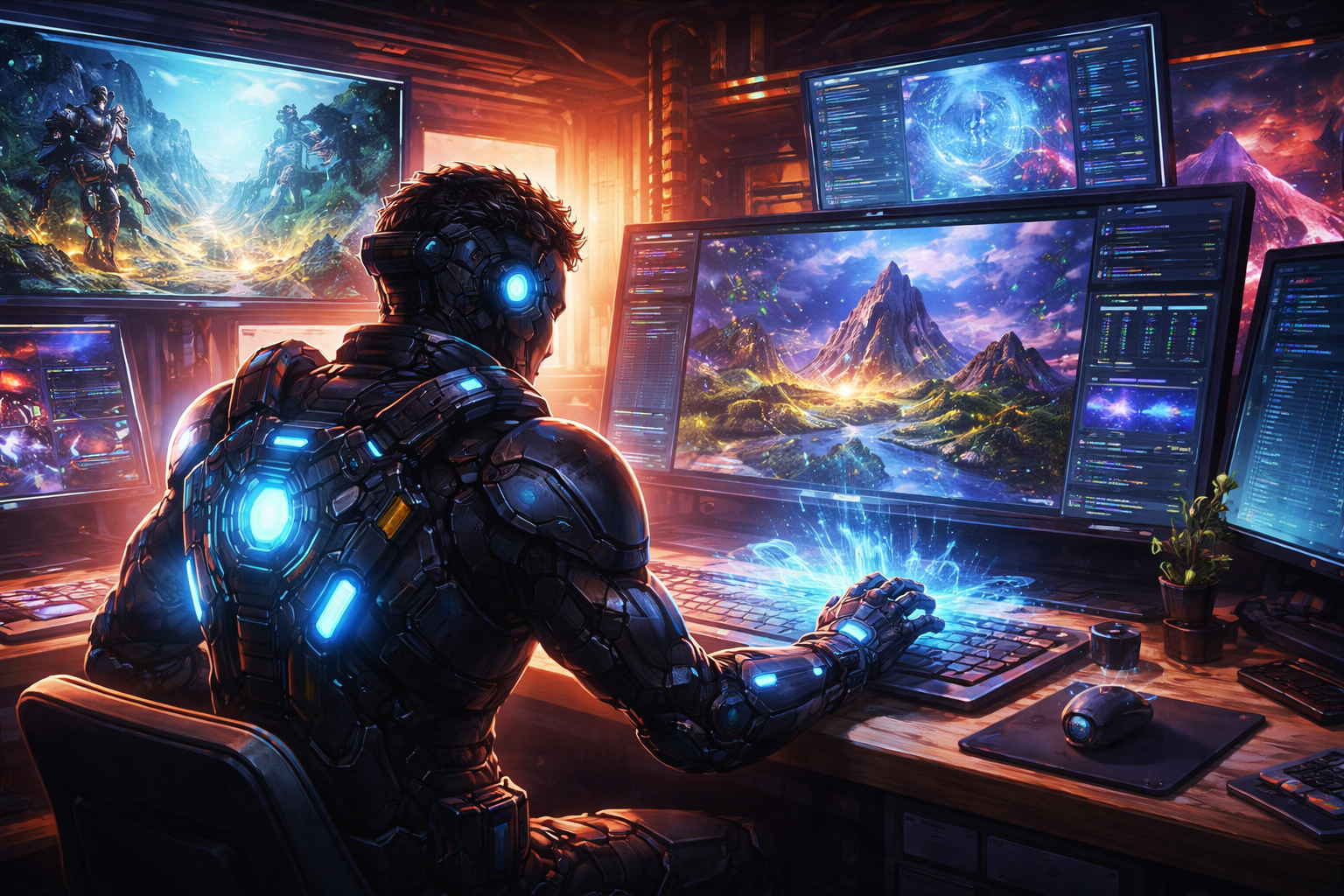
The gaming industry has always been at the forefront of technological evolution — from pixelated 2D worlds to photorealistic open universes. Now, a new revolution is reshaping how games are made: Artificial Intelligence (AI). For developers, AI isn’t just another tool — it’s becoming their “Iron Man suit,” empowering them with superhuman creative and technical abilities.
From Code Warriors to AI-Powered Creators
Traditionally, game development demanded an army of programmers, designers, animators, and testers. Creating assets, balancing gameplay, and fixing bugs could take years. But with AI entering the scene, developers are now able to build faster, smarter, and more creatively.
AI tools like ChatGPT, Runway ML, and Scenario AI are helping creators design environments, generate characters, and even write compelling storylines in a fraction of the time. What used to take months can now happen in days.
Imagine describing a medieval village, and AI instantly produces landscapes, NPC dialogues, and ambient sounds. This level of automation frees developers to focus on what truly matters — storytelling, strategy, and player experience.
AI in Game Design: Co-Creators, Not Replacements
AI is not here to replace human creativity but to amplify it. Just like Tony Stark relies on his suit but still makes the decisions, game developers remain the creative core behind the experience.
AI algorithms now assist in procedural content generation — creating endless terrains, unique characters, and dynamic missions based on player behavior. Studios like Ubisoft and Activision are already experimenting with AI tools that dynamically adjust game difficulty or predict player frustration to enhance engagement.
This “AI co-pilot” approach allows even indie developers to compete with big studios, making the industry more inclusive and diverse.
Smarter Testing and Debugging
Game testing has always been a resource-intensive task. AI is revolutionizing this too. Machine learning systems can now simulate thousands of gameplay hours, spotting bugs, imbalances, and exploits before human testers ever play the game.
For example, AI-based bots can automatically test different player choices, ensuring story consistency and detecting crashes in open-world environments. This dramatically shortens development cycles and improves overall quality.
The Rise of Personalized Gaming
AI also powers adaptive gameplay — where the game evolves with the player. Imagine a horror game that learns your fears or an RPG that changes storylines based on your playstyle. AI analyzes real-time behavior to craft unique experiences for every player, turning each playthrough into something personal.
The Future: Human Creativity + Machine Intelligence
In essence, AI is transforming game developers into super-creators. Like Tony Stark with his Iron Man suit, developers equipped with AI can visualize, build, and refine entire worlds faster than ever before. The result? Games that are more immersive, responsive, and imaginative.
As AI tools continue to evolve, the line between creator and creation will blur — and the next generation of developers will fly higher, faster, and smarter than ever before.