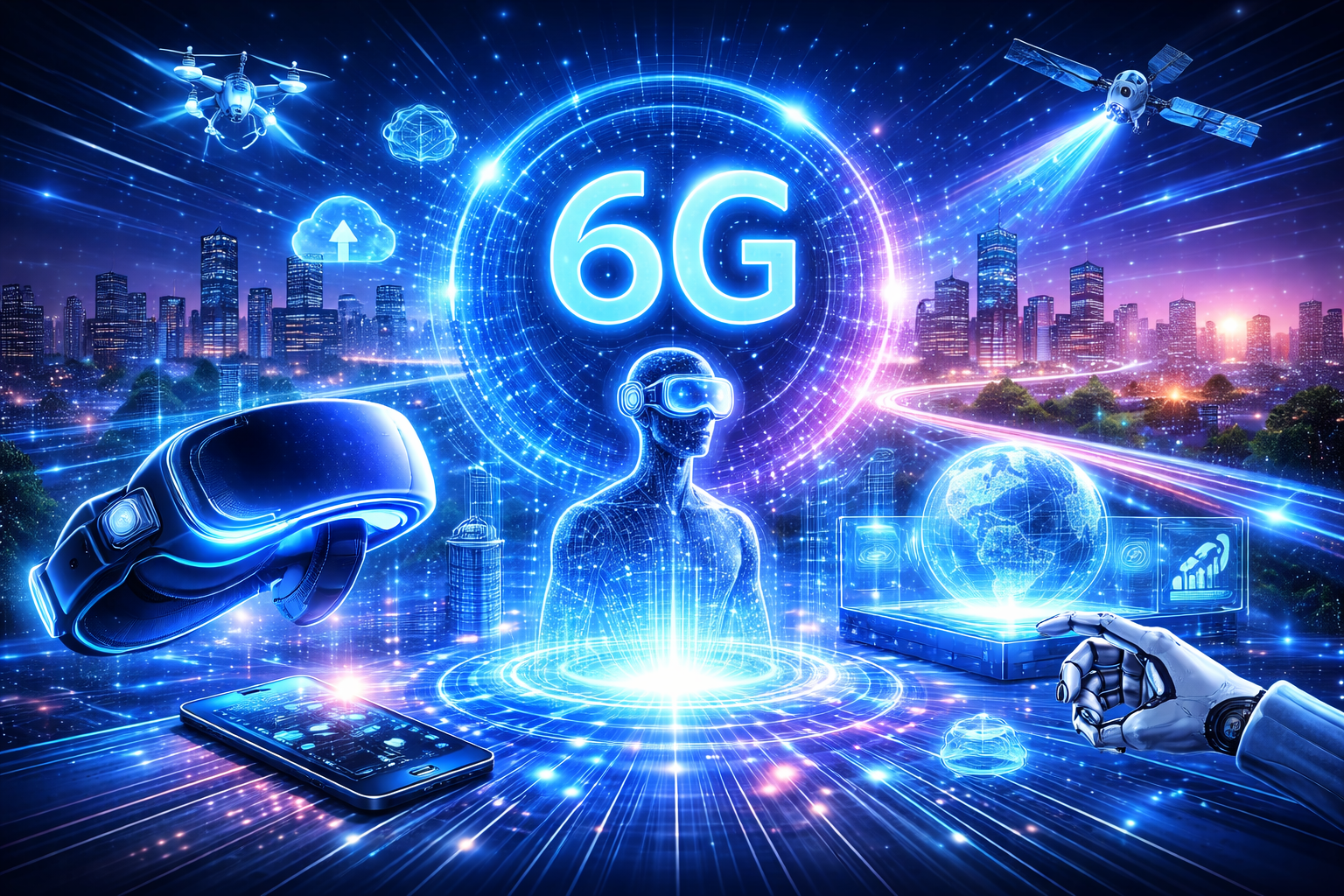

The world stands on the edge of another digital revolution. As 5G continues to roll out globally, the tech community is already looking ahead — toward 6G, Extended Reality (XR), and the convergence of smart systems that will redefine how humans interact with technology.
These innovations promise to blur the lines between physical and digital worlds, enabling faster communication, more immersive experiences, and new economic frontiers.
Welcome to the next tech frontier — where speed, intelligence, and reality itself evolve together.
6G: The Dawn of Hyperconnectivity
While 5G is still being adopted, researchers and telecom leaders are preparing for 6G, expected to launch commercially by 2030. Early trials are already underway in countries like South Korea, Japan, the United States, and Finland.
Unlike previous generations, 6G won’t just focus on speed — it will revolutionize latency, reliability, and sensing capabilities.
1. Unmatched Speed and Responsiveness
6G networks are predicted to deliver speeds up to 100 times faster than 5G, reaching 1 terabit per second (Tbps). Such bandwidth will allow real-time data sharing between devices, autonomous vehicles, and even smart cities — with latency as low as 1 microsecond.
This means near-instant communication between humans and machines — an essential foundation for AI-driven robotics and autonomous infrastructure.
2. AI-Native Network Design
6G will integrate Artificial Intelligence at its core. AI will optimize network resources dynamically, predict failures before they happen, and customize bandwidth based on user needs.
This intelligence layer transforms the network into a self-learning digital ecosystem, far beyond the static systems of the past.
3. Digital-Physical Fusion
6G will enable a “digital twin” reality, where physical and virtual environments operate in perfect sync.
For example, engineers could simulate real-time building performance through digital twins powered by 6G sensors — or doctors could perform remote surgeries with zero delay through holographic visualization.
6G is not just about faster connections — it’s about connecting everything with purpose.
XR: Extended Reality and the Next Human Interface
If 6G is the nervous system of the digital world, Extended Reality (XR) is its sensory experience. XR — which includes Virtual Reality (VR), Augmented Reality (AR), and Mixed Reality (MR) — is reshaping how people work, play, and communicate.
1. From Screens to Worlds
In the 2010s, we moved from desktop to mobile. In the 2020s, XR is taking us from screens to 3D spaces.
Through lightweight headsets, smart glasses, and spatial audio, XR experiences feel increasingly natural and immersive.
Imagine attending a global business meeting where holographic avatars replace video calls — or exploring a museum with virtual guides explaining artifacts in your living room.
2. The Rise of Spatial Computing
Tech giants like Apple (with Vision Pro), Meta, and Microsoft are investing heavily in spatial computing — the next evolution of XR that merges digital information with the real world in three-dimensional context.
Spatial computing lets users manipulate holograms, data models, and 3D workspaces through natural gestures and voice commands — eliminating the need for screens entirely.
3. Beyond Entertainment
While XR began in gaming and media, its true potential lies in enterprise, education, and healthcare.
-
Education: Immersive learning environments make complex subjects like astronomy or anatomy easier to understand.
-
Healthcare: XR assists in medical training, therapy, and remote surgeries.
-
Architecture & Design: Clients can virtually walk through their future homes before construction begins.
As hardware gets smaller, cheaper, and more powerful, XR will soon become as common as smartphones.
The Convergence: When 6G Meets XR
The real magic happens when 6G and XR converge.
Today’s XR experiences are limited by latency, resolution, and device performance. But with 6G, instantaneous rendering, cloud-based AI, and seamless holographic communication will become reality.
1. Cloud XR and Holographic Worlds
With 6G’s speed, XR devices won’t need heavy local processors. Instead, rendering will happen in the cloud, streaming ultra-realistic 3D content directly to lightweight headsets.
This will enable persistent holographic environments — virtual offices, social spaces, or entertainment hubs that users can access from anywhere.
2. Human-Machine Collaboration
6G’s AI-driven connectivity will empower real-time collaboration between humans and machines. Imagine controlling industrial robots through XR interfaces or diagnosing equipment via virtual overlays powered by AI analytics.
This will redefine productivity across manufacturing, logistics, and service industries.
3. Metaverse Reinvented
The metaverse — once a buzzword — will evolve into something tangible.
Instead of centralized platforms, 6G-enabled XR ecosystems will be interoperable and decentralized, powered by blockchain and real-time data exchange.
These connected worlds could host digital economies where goods, assets, and skills move freely across platforms.
Challenges on the Frontier
Despite the excitement, this new frontier isn’t without hurdles:
-
Infrastructure: Building global 6G networks requires massive investment and standardization.
-
Privacy & Security: More connectivity means more vulnerabilities. AI-native networks must guard against cyber threats.
-
Accessibility: XR and 6G technologies must remain affordable and inclusive to prevent a new digital divide.
-
Ethics & Regulation: Transparent data policies and user consent will be crucial as virtual and real identities merge.
Addressing these challenges will shape how society benefits from this technological leap.
The Future Is Closer Than You Think
The convergence of 6G and XR represents more than technological evolution — it’s a new way of living and perceiving reality.
From holographic communication to intelligent cities and immersive digital workspaces, these innovations will transform industries, cultures, and human connections.
As we move toward 2030, the question isn’t if this transformation will happen — but how ready we are to embrace it.