
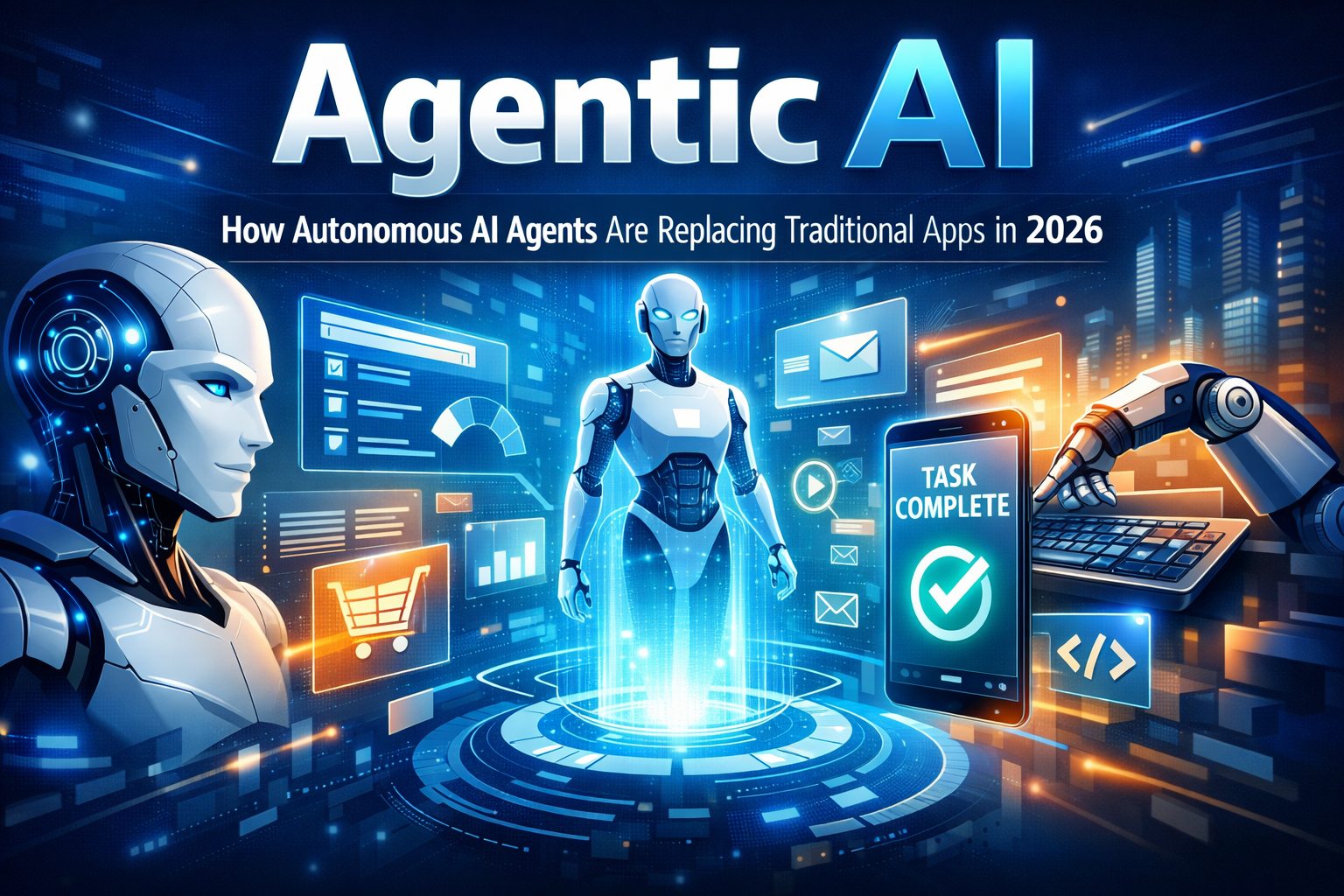
The world of technology is evolving at an unprecedented pace, and 2026 is shaping up to be the year of Agentic AI. While most people are familiar with AI tools like chatbots and content generators, a new wave of innovation is taking things much further. Instead of simply responding to commands, AI systems are now capable of thinking, planning, and acting independently. These systems are known as autonomous AI agents, and they are rapidly replacing traditional apps.
In this blog, we’ll explore what Agentic AI is, how it works, and why it is becoming the next big thing in technology.
What is Agentic AI?
Agentic AI refers to artificial intelligence systems that can operate independently to achieve specific goals. Unlike traditional AI tools that require constant human input, these agents can:
- Understand tasks
- Break them into steps
- Make decisions
- Execute actions
- Learn from outcomes
In simple terms, Agentic AI behaves more like a digital employee rather than a tool.
For example, instead of using separate apps for research, writing, and publishing a blog, an AI agent can handle the entire workflow—from idea generation to final publishing—on its own.
Agentic AI vs Traditional Apps
To understand the impact of this shift, let’s compare Agentic AI with traditional applications:
Traditional Apps
- Require manual input for every step
- Perform single, specific functions
- Depend heavily on user interaction
- Example: You use one app for email, another for writing, and another for scheduling
Agentic AI
- Works autonomously with minimal input
- Handles multi-step complex tasks
- Makes decisions based on context
- Acts like a personal assistant or team member
This shift is similar to moving from manual labor to automation, but on a much larger and smarter scale.
How Autonomous AI Agents Work
Agentic AI systems operate using a combination of advanced technologies:
1. Goal Understanding
The agent receives a high-level instruction like:
“Create a marketing campaign for a new product.”
2. Task Planning
It breaks down the goal into smaller steps:
- Market research
- Competitor analysis
- Content creation
- Campaign launch
3. Execution
The AI interacts with tools, APIs, and platforms to complete each step automatically.
4. Learning & Optimization
It continuously improves by analyzing results and adjusting strategies.
This ability to plan + act + improve makes Agentic AI extremely powerful.
Real-World Use Cases of Agentic AI in 2026
Agentic AI is already transforming multiple industries. Here are some powerful use cases:
1. Content Creation & Blogging
AI agents can:
- Research trending topics
- Write SEO-optimized articles
- Generate images and videos
- Publish content automatically
For bloggers, this means scaling content production like never before.
2. Business Automation
Companies are using AI agents to:
- Handle customer support
- Manage emails
- Automate workflows
- Analyze business data
This reduces operational costs and increases efficiency.
3. Software Development
AI agents can now:
- Write code
- Debug errors
- Deploy applications
This is revolutionizing how developers work and speeding up project delivery.
4. E-commerce & Marketing
AI agents can:
- Run ad campaigns
- Optimize product listings
- Analyze customer behavior
- Increase conversions
This is especially powerful for dropshipping and online businesses.
Why Agentic AI is Replacing Traditional Apps
There are several reasons why businesses and individuals are shifting toward Agentic AI:
1. Time Efficiency
Instead of switching between multiple apps, a single AI agent handles everything.
2. Cost Reduction
Businesses can replace multiple tools and even some roles with AI agents.
3. Increased Productivity
Tasks that used to take hours can now be completed in minutes.
4. Better Decision-Making
AI agents analyze data in real time and make smarter decisions.
Impact on Jobs and Work
One of the biggest concerns around Agentic AI is its impact on jobs.
What Will Change?
- Repetitive and manual jobs may decline
- Demand for AI-related skills will increase
- New roles like “AI Manager” or “Prompt Engineer” will grow
What Will Stay Important?
- Creativity
- Strategy
- Human decision-making
Rather than replacing humans completely, Agentic AI will augment human capabilities.
Challenges and Risks of Agentic AI
Despite its benefits, Agentic AI comes with challenges:
1. Lack of Control
Autonomous systems can make decisions that may not always align with human expectations.
2. Security Risks
AI agents interacting with multiple systems can create vulnerabilities.
3. Ethical Concerns
Questions around accountability and bias still exist.
4. Over-Reliance
Excessive dependence on AI can reduce human skills over time.
These challenges highlight the need for responsible AI development.
The Future of Agentic AI (2026–2030)
The future of Agentic AI is incredibly promising. In the coming years, we can expect:
- AI agents replacing most traditional apps
- Fully automated businesses run by AI
- Personal AI assistants managing daily life
- AI teams collaborating with humans
Imagine a world where you simply give a goal, and AI handles everything—from execution to optimization.
That future is not far away.
Conclusion
Agentic AI is not just another tech trend—it is a fundamental shift in how we interact with technology. By moving from tools to autonomous agents, we are entering a new era of efficiency, automation, and intelligence.
For businesses, creators, and entrepreneurs, this is a massive opportunity. Those who adopt Agentic AI early will have a significant advantage in productivity, scalability, and innovation.
If 2024 was the year of Generative AI, then 2026 is the year of Agentic AI.