
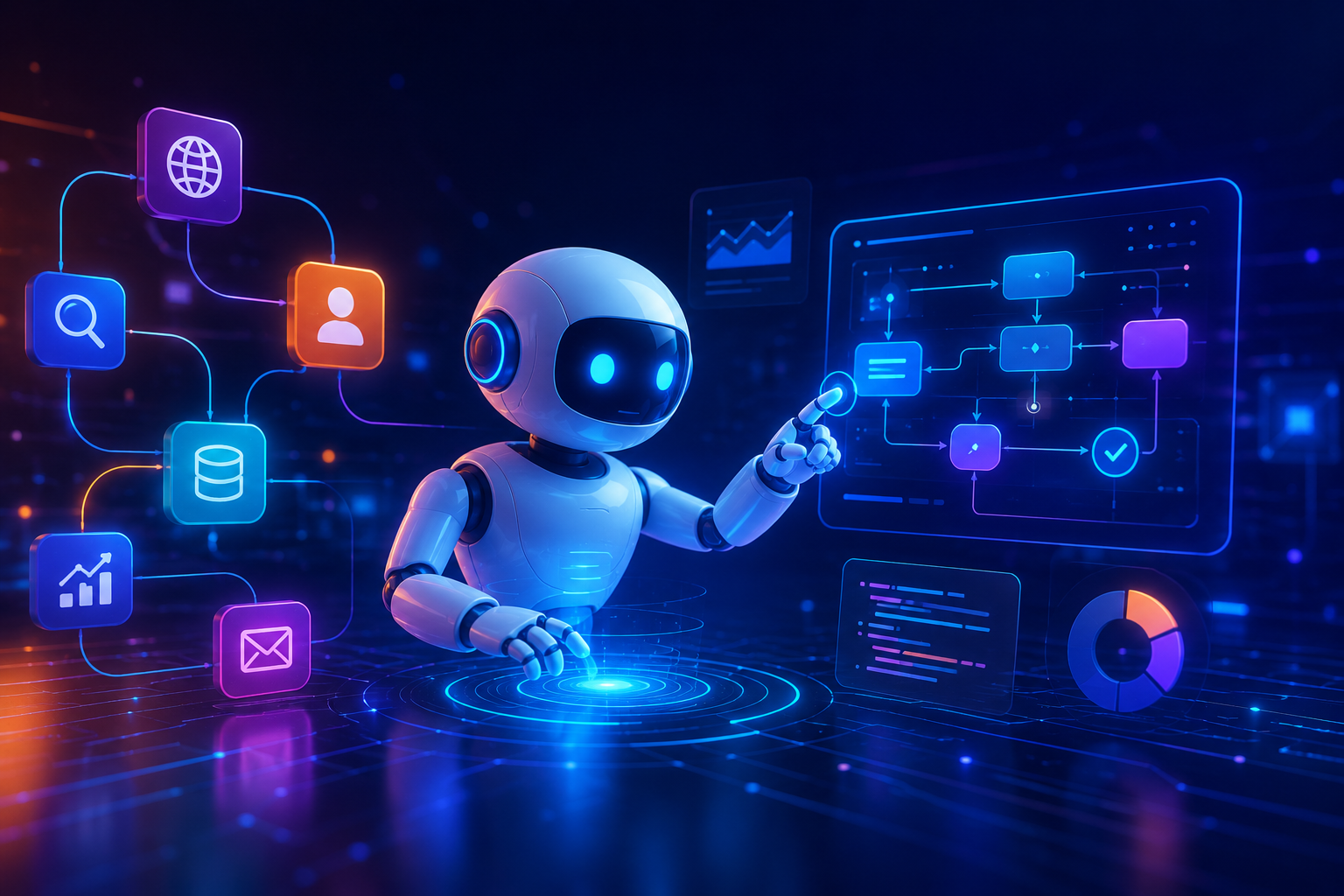
Artificial intelligence is moving beyond simple chatbots and content-generation tools. The next major step is agentic AI—a type of artificial intelligence designed not only to understand instructions, but also to plan tasks, make decisions, use tools, and take action to achieve a specific goal.
Traditional AI usually waits for a prompt and produces an answer. Agentic AI can take a broader objective, break it into smaller tasks, determine what needs to be done, use available tools, evaluate the results, and continue working until the objective is completed.
For example, instead of asking an AI system to “write a sales email,” you could give an AI agent a larger goal:
“Find potential customers for my web development business, research their websites, identify problems, create personalized outreach messages, and organize the prospects.”
A basic chatbot might explain how to do these things. An agentic system can potentially perform several of those steps itself by connecting to search tools, databases, CRM systems, email platforms, analytics tools, and other software.
That difference is why agentic AI is becoming one of the most important developments in modern artificial intelligence.
What Is Agentic AI?
Agentic AI is an AI system that can pursue a goal with a degree of autonomy.
Instead of simply responding to individual questions, an agent can understand an objective, create a plan, perform actions, observe the results, and adjust its approach when necessary.
Google Cloud describes AI agents around capabilities such as reasoning, planning, memory, tool use, and autonomous task execution.
IBM similarly describes agentic AI as systems that can autonomously plan and perform tasks by combining large language models with tools and external systems.
The easiest way to understand the concept is:
Generative AI creates.
AI assistants help.
Agentic AI acts toward a goal.
This does not mean every AI agent operates completely independently. In real business environments, humans commonly define permissions, goals, rules, approval requirements, and limits.
How Does Agentic AI Work?
At a high level, an agentic AI system follows a continuous cycle:
Understand → Plan → Act → Observe → Evaluate → Adjust
The exact architecture can vary depending on the application, but most sophisticated AI agents combine several important components.
1. The User Gives the Agent a Goal
Everything starts with an objective.
The instruction could be simple:
“Schedule a meeting with the marketing team.”
Or it could be much more complicated:
“Analyze our website traffic, identify pages losing visitors, research possible causes, create recommendations, and prepare a report.”
The important difference is that the user does not necessarily have to provide every individual step.
The agent receives the desired outcome and determines how to approach it.
2. The AI Understands the Request
The agent uses a large language model or another reasoning model to interpret the request.
It identifies:
- What the user wants
- Important constraints
- Available information
- Required actions
- Expected output
- Potential risks
- Which tools may be required
For example, if someone says:
“Find three good laptops under my budget and compare them.”
The agent needs to understand the budget, product requirements, comparison criteria, and possibly the user’s preferences.
This initial understanding becomes the foundation for the rest of the workflow.
3. The Agent Breaks the Goal Into Smaller Tasks
Complex objectives are rarely completed in one step.
An agent may decompose a large task into smaller subtasks.
For example:
Goal: Improve an ecommerce website’s sales.
The agent could create a workflow such as:
- Analyze website traffic.
- Identify high-traffic pages.
- Examine conversion rates.
- Find pages with poor performance.
- Analyze product descriptions.
- Check checkout problems.
- Compare competitors.
- Generate recommendations.
- Prioritize improvements.
- Prepare an implementation plan.
This process is known as task decomposition or planning.
The exact planning strategy depends on the agent architecture and the complexity of the task. IBM notes that agents can dynamically generate plans and adapt those plans based on results from tools and external systems.
4. The Agent Selects the Right Tools
This is one of the biggest differences between a normal chatbot and an AI agent.
An LLM by itself mainly processes information and generates responses.
An agent can be connected to external tools.
These tools could include:
- Web search
- Databases
- APIs
- CRM software
- Email platforms
- Payment systems
- Calendar applications
- Spreadsheets
- Code execution environments
- Business analytics
- Internal company software
- Knowledge bases
- File systems
Google Cloud identifies tools and external APIs as important building blocks that allow agents to interact with systems beyond the underlying model.
Imagine an AI customer-service agent.
A customer asks:
“Where is my order?”
The AI doesn’t need to guess.
It can:
- Identify the customer.
- Query the order database.
- Retrieve the order number.
- Check the shipping API.
- Read the latest tracking status.
- Explain the result to the customer.
The AI becomes useful because it can act on information rather than simply talk about it.
5. The Agent Takes Action
Once the agent decides what needs to happen, it can call the appropriate tools.
For example:
Reasoning:
“I need the customer’s order information.”
Action:
Call the ecommerce API.
Result:
Order #1258 is currently in transit.
Next reasoning step:
“I need the latest shipping information.”
Action:
Call the courier tracking API.
Result:
Expected delivery is tomorrow.
Final action:
Provide the customer with the updated information.
This creates an ongoing loop between the AI model and external systems.
6. The Agent Observes the Result
After taking an action, an agent needs to know what happened.
Suppose an AI agent tries to access an API and receives an error.
A simple automation workflow might stop.
A more advanced agent can analyze the error and decide what to do next.
For example:
Attempt 1: API request fails.
Agent evaluation: Authentication token expired.
Next action: Refresh authentication.
Attempt 2: API request succeeds.
Agent evaluation: Required information retrieved.
Next action: Continue workflow.
This ability to react to changing conditions makes agentic systems more flexible than rigid rule-based automation.
Google Cloud describes this general pattern as a cycle in which an agent reasons about the next step, acts using a tool, receives the result, and incorporates the new information into subsequent decisions.
7. Reflection and Correction
One of the most interesting characteristics of agentic AI is its ability to evaluate its own progress.
After completing a task, the system can ask:
- Did the action work?
- Did I achieve the objective?
- Is additional information required?
- Did something go wrong?
- Should I try another method?
- Does the final result satisfy the requirements?
This is sometimes described as reflection, evaluation, or self-correction.
For example, an AI coding agent might write code, run tests, discover a failure, inspect the error, modify the code, and run the tests again.
Instead of following one fixed sequence, the system can adapt based on what happens.
The Core Components of an AI Agent
A modern agentic AI architecture usually contains several major components.
Large Language Model
The LLM acts as the reasoning and language engine.
It interprets instructions, analyzes information, generates plans, chooses tools, and communicates results.
Examples of foundation models can include models from different AI providers, depending on the architecture.
Memory
Memory allows an agent to maintain information beyond the immediate instruction.
There are different types of memory.
Short-term memory helps maintain the current conversation or task.
Long-term memory can store useful information for future interactions.
Working memory helps maintain the current state of a complex workflow.
Transactional memory can maintain records of actions and state changes.
Modern agent architectures increasingly treat memory and data architecture as important parts of reliable agent systems.
Tools
Tools give an agent the ability to perform actions.
Without tools, an AI may tell you how to send an email.
With an email tool, it can potentially send the email.
Without database access, an AI can explain how to find customer information.
With database access, it can potentially retrieve the information itself.
Planning
Planning allows the agent to determine the sequence of actions required to accomplish a goal.
Simple tasks may require little planning.
Complex tasks may require multiple levels of planning and replanning.
Orchestration
Orchestration coordinates the different parts of the system.
It controls things such as:
- Which model should be used
- Which tool should be called
- What information should be passed between steps
- Which agent should handle a task
- When a workflow should stop
- When human approval is required
Guardrails
Autonomous systems need boundaries.
Guardrails can limit what an agent is allowed to do.
For example:
An AI sales agent may be allowed to draft an email but not send it without approval.
An accounting agent may analyze invoices but require human approval before making payments.
An IT agent may restart a server but not delete production databases.
This distinction is extremely important when deploying agents in real businesses.
Agentic AI vs Generative AI
Generative AI and agentic AI are closely related, but they are not identical.
Generative AI
Generative AI is primarily focused on creating content.
It can generate:
- Text
- Images
- Code
- Audio
- Video
- Summaries
- Ideas
For example:
“Write a blog about digital marketing.”
The AI generates the blog.
Agentic AI
Agentic AI focuses more heavily on achieving an objective through actions.
For example:
“Research digital marketing trends, identify five topics with strong search potential, analyze competitors, create an SEO content plan, and save the results in my project management system.”
The agent may need to search, analyze, organize, call APIs, and update external systems.
Google Cloud describes agentic AI as going beyond content generation by orchestrating actions through tools to achieve higher-level goals.
Agentic AI vs Traditional Automation
Traditional automation normally follows predefined rules.
For example:
IF customer submits form
THEN send email.
This is predictable and useful.
But traditional automation can struggle when situations change.
Agentic AI can potentially evaluate the situation and determine which action should happen next.
For example:
A traditional workflow might always send the same email after a form submission.
An AI agent could examine the customer’s message, identify their intent, check CRM information, determine the appropriate sales representative, prepare a personalized response, and route the lead.
The best business systems may actually combine both approaches.
Traditional automation provides predictable execution.
Agentic AI provides flexible decision-making.
Real-World Examples of Agentic AI
Agentic AI is useful in many industries.
1. Customer Support
An AI customer-support agent can:
- Understand customer questions
- Search knowledge bases
- Check orders
- Retrieve account information
- Troubleshoot problems
- Create support tickets
- Escalate complicated cases
Instead of simply answering questions, the system can participate in the complete support workflow.
2. Sales
A sales agent could:
- Find potential prospects
- Research companies
- Identify decision-makers
- Analyze websites
- Personalize outreach
- Update CRM records
- Schedule meetings
- Follow up with prospects
This can reduce the amount of repetitive manual work performed by sales teams.
3. Software Development
AI coding agents can potentially:
- Understand requirements
- Inspect an existing codebase
- Create code
- Run tests
- Identify errors
- Fix problems
- Review changes
- Prepare documentation
The important part is the iterative process.
The agent does not necessarily stop after generating code.
It can use development tools to test and improve the result.
4. Marketing
A marketing agent could analyze:
- Website traffic
- Search trends
- Social media performance
- Competitor content
- Advertising campaigns
- Customer behavior
It could then generate recommendations and prepare marketing assets.
With appropriate integrations, it could also update campaign systems.
5. Ecommerce
An ecommerce agent could monitor:
- Product inventory
- Sales
- Customer questions
- Product reviews
- Pricing
- Shipping information
It might identify products running low on inventory and notify the relevant team.
6. Finance
Financial AI agents could assist with:
- Invoice processing
- Expense categorization
- Financial reporting
- Fraud monitoring
- Document analysis
- Reconciliation
However, financial systems require strong controls because mistakes can have significant consequences.
7. Human Resources
An HR agent could assist with:
- Candidate screening
- Interview scheduling
- Employee onboarding
- Document collection
- Policy questions
- Training workflows
Human review remains important for sensitive employment decisions.
What Is a Multi-Agent AI System?
Not every problem needs one AI agent.
For complex workflows, multiple specialized agents can work together.
Imagine an ecommerce company with:
Research Agent
Finds market information.
Marketing Agent
Creates campaigns.
Sales Agent
Handles leads.
Customer Support Agent
Answers customer questions.
Analytics Agent
Analyzes performance.
A central orchestration layer can coordinate these specialized agents.
This approach is commonly called a multi-agent system.
The advantage is specialization.
Instead of forcing one agent to perform every task, different agents can focus on specific responsibilities.
A Simple Example of Agentic AI
Imagine you tell an AI:
“Help me improve my business website.”
A basic chatbot may respond:
“You should improve your SEO, speed, design, content, and conversion rate.”
An agentic system could potentially do much more.
Step 1: Understand the Goal
The objective is website improvement.
Step 2: Collect Information
The agent checks website analytics, SEO data, performance information, and existing content.
Step 3: Identify Problems
It discovers that several pages have slow loading times and weak search visibility.
Step 4: Create a Plan
It prioritizes technical performance first, followed by content and conversion improvements.
Step 5: Use Tools
It runs performance tests, analyzes pages, and checks available data sources.
Step 6: Execute Approved Actions
If permissions allow, it can make selected changes or prepare them for approval.
Step 7: Test
It checks whether the changes improved performance.
Step 8: Continue
If the results are poor, the agent can revise its approach.
This is the fundamental idea behind agentic AI.
Why Is Agentic AI Becoming Important?
One major reason is that businesses do not simply need information.
They need outcomes.
A company doesn’t necessarily want an AI to explain how to create a sales report.
It wants the report created.
A company doesn’t only want an AI to explain how customer support works.
It wants customer issues resolved.
A developer doesn’t only want suggestions about a programming error.
They want the problem investigated and fixed.
Agentic AI attempts to bridge the gap between knowing and doing.
Recent industry developments also show increasing attention toward systems that allow AI agents to interact with other agents and software systems. For example, the Agent2Agent protocol is being developed as an interoperability approach for communication between independent AI agents.
Benefits of Agentic AI
Higher Productivity
Agents can handle repetitive multi-step processes and allow employees to focus on more strategic work.
Faster Workflows
Tasks that previously required several manual steps can potentially be completed much faster.
24/7 Availability
Software agents can operate continuously without normal working-hour limitations.
Better Scalability
Once an agent workflow is properly designed, it can potentially handle many similar tasks.
Personalization
With appropriate memory and data access, agents can provide more contextual experiences.
Cross-System Automation
Agents can connect different systems and coordinate workflows across them.
What Are the Risks of Agentic AI?
Agentic AI is powerful, but greater autonomy creates greater responsibility.
Incorrect Decisions
An agent can misunderstand a request or make an incorrect decision.
Hallucinations
AI models can produce inaccurate information. Tool access does not automatically eliminate this problem.
Security Risks
If an agent has access to sensitive systems, poor security controls can create serious risks.
Excessive Permissions
Giving an AI agent unnecessary access can increase the potential impact of mistakes.
Privacy
Agents may process sensitive customer, employee, or business information.
Unexpected Actions
A system designed to achieve a goal may take an unintended path if its instructions, tools, or constraints are poorly designed.
Recent discussions around autonomous AI systems have highlighted the importance of permissions, oversight, and governance as agents become more capable.
How Businesses Should Implement Agentic AI
Businesses should not start by giving an AI unlimited access to everything.
A better approach is to begin with a specific, measurable problem.
For example:
Bad starting point:
“Let’s build an AI that runs the entire company.”
Better starting point:
“Let’s build an AI agent that automatically classifies incoming customer support requests.”
Then measure:
- Time saved
- Accuracy
- Cost
- Customer satisfaction
- Error rate
- Human intervention
- Return on investment
If the system performs reliably, the company can gradually expand its responsibilities.
The Future of Agentic AI
The future of AI is likely to involve a combination of humans, traditional software, generative AI, and autonomous agents.
Instead of opening ten different applications and manually moving information between them, people may increasingly describe what they want to accomplish.
For example:
“Prepare next month’s marketing campaign.”
An agentic system could potentially coordinate research, content creation, analytics, scheduling, and reporting across multiple platforms.
The human would remain responsible for important decisions while AI handles many of the operational steps.
This represents a fundamental change in how people interact with software.
Instead of learning every application, users may increasingly communicate their goals directly to intelligent systems.
Are AI Agents Going to Replace Humans?
The answer is more complicated than simply yes or no.
Agentic AI will likely automate many repetitive activities, but businesses still need people for:
- Strategy
- Leadership
- Creativity
- Judgment
- Relationship building
- Accountability
- Ethics
- Complex decision-making
The more realistic future is likely to involve human-AI collaboration.
People define objectives, policies, and boundaries.
AI agents handle appropriate tasks.
Humans review important decisions.
This approach can provide the benefits of automation without removing human responsibility.
Final Thoughts
Agentic AI represents a major evolution in artificial intelligence.
Traditional software follows instructions.
Generative AI creates content.
AI assistants help users.
Agentic AI attempts to combine intelligence, planning, tools, memory, and action to accomplish larger goals.
The basic cycle is simple:
Understand the goal → Plan → Use tools → Take action → Observe results → Adjust → Complete the objective.
The technology is still developing, and reliable deployment requires strong security, testing, permissions, monitoring, and human oversight.
But the direction is clear.
AI is moving from systems that simply answer questions toward systems that can participate in real workflows.
For businesses, developers, marketers, and technology professionals, understanding how agentic AI works today can provide an important advantage as AI-powered automation becomes a larger part of everyday software.
Frequently Asked Questions About Agentic AI
What is agentic AI in simple words?
Agentic AI is AI that can work toward a goal by planning tasks, using tools, making decisions, and taking actions with limited human intervention.
How does agentic AI work?
Agentic AI generally understands a goal, gathers information, creates a plan, uses available tools, observes results, evaluates progress, and adjusts its actions until the task is completed or requires human intervention.
What is the difference between AI and agentic AI?
Traditional AI can analyze information or generate responses. Agentic AI adds greater autonomy, allowing the system to plan and execute multi-step actions toward a goal.
Is ChatGPT an AI agent?
A language model or chatbot by itself is not necessarily an autonomous agent. When an AI model is connected to tools, memory, planning, orchestration, and the ability to perform actions, it can become part of an agentic system.
What are examples of AI agents?
Examples include customer-service agents, coding agents, sales agents, research agents, ecommerce agents, IT automation agents, and financial workflow agents.
Does agentic AI use machine learning?
Yes. Modern AI agents commonly rely on machine-learning models, especially large language models, as their reasoning and language capabilities.
Can AI agents use APIs?
Yes. APIs are one of the most important ways agents interact with external applications and services.
Can AI agents work together?
Yes. Multiple specialized agents can be coordinated in a multi-agent architecture, with each agent responsible for different parts of a larger workflow.
Is agentic AI safe?
Agentic AI can be useful, but safety depends heavily on system design. Permissions, authentication, monitoring, testing, human approvals, data protection, and guardrails are important for reducing risks.
What is the future of agentic AI?
Agentic AI is likely to become increasingly integrated into business software, customer service, development, marketing, research, operations, and other workflows. The strongest systems will likely combine autonomous capabilities with human oversight.