
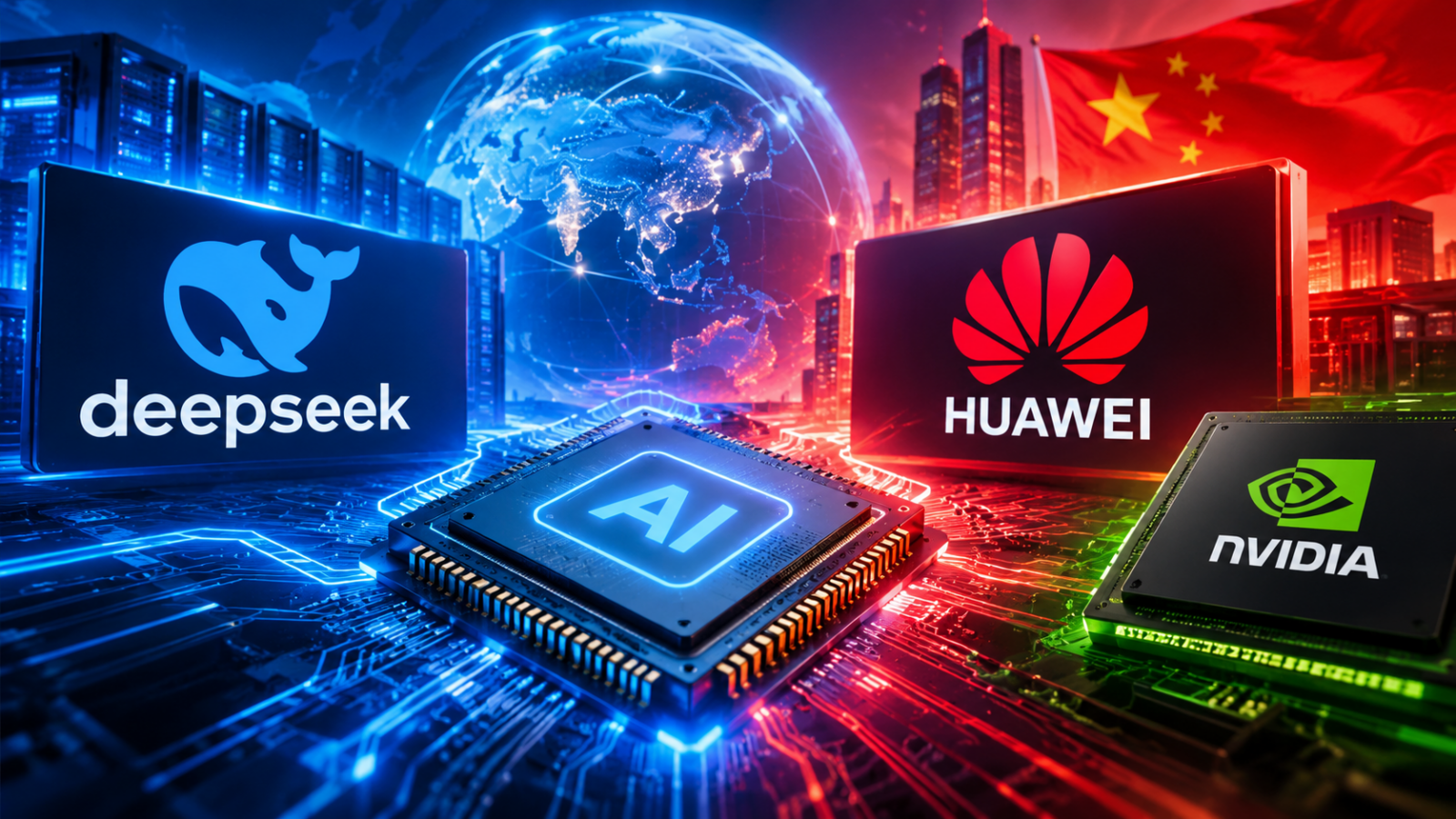
The global AI race is no longer just about who can build the smartest AI model. It is increasingly about who controls the chips, software, and infrastructure needed to run those models.
A new partnership between Chinese AI company DeepSeek and technology giant Huawei is putting that issue back in the spotlight.
On September 30, 2026, DeepSeek announced that it is working with Huawei to develop programming tools optimized for Huawei’s Ascend AI chips. DeepSeek is also open-sourcing parts of the software infrastructure designed for the Ascend platform.
The goal is bigger than simply supporting another processor. The collaboration could help create a more complete AI hardware and software ecosystem around Huawei chips, reducing dependence on Nvidia’s widely used CUDA platform.
But does this mean Huawei is ready to replace Nvidia?
Not yet. The more interesting story is how DeepSeek and Huawei are trying to build an alternative AI technology stack.
What Is the DeepSeek and Huawei Partnership?
DeepSeek became one of the most talked-about AI companies after developing models that attracted worldwide attention.
Huawei, meanwhile, has been investing heavily in its own AI processors and computing infrastructure through its Ascend chip family.
The latest partnership brings these two efforts together.
DeepSeek is helping develop software tools that can make it easier for developers to build and optimize AI applications for Huawei’s Ascend hardware. The collaboration includes open-source infrastructure such as computing and communication libraries.
One of the technologies involved is TileLang, an open-source programming language designed to make AI kernel development more accessible across different hardware platforms.
In simple terms, the idea is this:
Better chips need better software.
A powerful AI processor is not very useful if developers struggle to write, optimize, and deploy applications for it.
That is one of the biggest advantages Nvidia has built over the years.
Why Nvidia’s CUDA Ecosystem Matters
Nvidia’s strength in AI is not based only on its GPUs.
Its software ecosystem is a major part of the company’s position in the market.
One of the best-known pieces is CUDA, Nvidia’s programming platform that allows developers to use Nvidia GPUs for high-performance computing and AI workloads.
Over many years, developers have built tools, libraries, frameworks, and applications around CUDA.
This creates a powerful ecosystem effect.
A company considering AI hardware does not simply ask:
“Which chip is fastest?”
It also needs to consider:
- What software supports the chip?
- Can developers easily program it?
- Which AI frameworks work with it?
- How difficult is migration?
- Are optimization tools available?
- Can the hardware scale across large data centers?
This is why DeepSeek’s work on Huawei’s software stack is important.
It is an attempt to address the software side of the AI chip competition.
Huawei Ascend: China’s Alternative AI Hardware
Huawei’s Ascend processors are designed for AI computing and are becoming increasingly important in China’s domestic technology ecosystem.
Huawei has also been developing larger computing systems that connect many AI processors together.
The latest DeepSeek collaboration includes a new supernode solution using 128 Ascend 950 chips, according to Reuters.
This approach is significant because AI performance is not determined by a single chip alone.
Large AI models can require thousands of processors working together.
That makes networking, memory, software, and communication between chips extremely important.
Huawei is therefore competing at the system level, not simply by trying to produce one GPU that looks identical to an Nvidia product.
Why DeepSeek Needs an Alternative to Nvidia
There are several reasons DeepSeek and other Chinese AI companies have strong incentives to develop domestic alternatives.
One is access to advanced computing hardware.
US export restrictions have limited Chinese companies’ access to some advanced AI processors. This has increased pressure on China’s technology industry to develop domestic alternatives. Reuters has reported that Huawei has become an increasingly important supplier of high-performance AI computing in China.
For DeepSeek, developing software that works efficiently on Huawei hardware can provide more flexibility.
Instead of depending on one hardware and software ecosystem, DeepSeek can build expertise around another platform.
That could become increasingly valuable as AI demand grows.
This Is About Software as Much as Chips
The most important part of this story may not actually be the Ascend 950 chip.
It could be the software.
Imagine buying a new smartphone with excellent hardware but almost no useful apps.
The hardware may be impressive, but the ecosystem limits its usefulness.
AI accelerators face a similar problem.
Developers need:
- Compilers
- Libraries
- Framework support
- Debugging tools
- Optimization tools
- Networking software
- Distributed computing support
DeepSeek’s decision to open-source parts of its Ascend infrastructure could help developers experiment with Huawei hardware more easily.
If more developers begin using these tools, the ecosystem could gradually become stronger.
Could Huawei Actually Challenge Nvidia?
That depends on what “challenge” means.
Replacing Nvidia globally would be extremely difficult.
Nvidia has a mature hardware platform, extensive developer adoption, networking technology, software libraries, and years of investment behind its AI ecosystem.
Huawei is starting from a different position.
However, Huawei does not necessarily need to replace Nvidia everywhere.
A more realistic objective is to establish a strong alternative ecosystem, particularly within China.
If Chinese AI companies increasingly train and run models on Huawei hardware, demand for Nvidia’s technology in that market could decline.
Reuters recently reported that Huawei has been gaining ground in China’s AI chip market as domestic companies invest more heavily in local computing infrastructure.
DeepSeek Is Also Working on Its Own AI Chip
The competition is becoming even more interesting because DeepSeek itself has reportedly been exploring custom AI hardware.
Reuters reported in July that DeepSeek was developing an AI chip designed primarily for inference — the stage where a trained AI model generates responses for users.
This suggests that DeepSeek’s long-term strategy may involve more control over the entire AI computing stack.
That could eventually include:
AI models → software → chips → data centers → AI services
Controlling more parts of this chain can potentially reduce dependence on outside suppliers.
However, developing advanced AI chips at scale is extremely difficult, so this remains a developing area rather than an established replacement for Nvidia hardware.
Why Open Source Could Matter
Another interesting part of the DeepSeek-Huawei strategy is open source.
Open-source software allows developers to inspect, modify, improve, and adapt technology.
DeepSeek has already gained attention for its open-source approach to AI models and software.
Applying a similar approach to AI chip infrastructure could help Huawei attract developers who want alternatives to proprietary platforms.
The more developers use a platform, the more useful its ecosystem can become.
That creates a potential cycle:
More developers → more software → better optimization → more adoption → larger ecosystem
This is one of the reasons the software battle could be just as important as the hardware battle.
What Does This Mean for Nvidia?
Nvidia remains one of the most important companies in AI computing.
The DeepSeek-Huawei partnership does not suddenly change that.
Instead, it highlights a growing trend: AI hardware competition is becoming more regional and more diversified.
Companies are looking at alternatives because of:
- Export restrictions
- Supply-chain concerns
- Hardware costs
- AI computing demand
- Data-center requirements
- Strategic technology independence
For Nvidia, this means that competition may increasingly come from complete ecosystems rather than individual chip manufacturers.
AMD, Huawei, custom cloud chips, and other specialized processors are all part of a broader shift toward a more diverse AI hardware market.
Why the AI Chip War Matters to Ordinary Users
At first glance, AI processors may seem like something only engineers and large technology companies should care about.
But the chip competition can eventually affect everyday users.
AI hardware influences the cost and availability of services such as:
- AI chatbots
- AI search
- Image generation
- Video generation
- AI coding tools
- Cloud applications
- Smartphone AI features
If companies can run AI workloads more efficiently, they may be able to reduce computing costs.
At the same time, increased competition can encourage investment in new processors and software.
That could eventually lead to more choices for businesses building AI products.
What Happens Next?
The DeepSeek-Huawei partnership is still developing.
The biggest question is whether the software work can make Huawei’s Ascend platform easier and more attractive for AI developers.
If that happens, Huawei could build a stronger domestic AI ecosystem around its hardware.
DeepSeek’s role is particularly interesting because the company is not simply a hardware manufacturer.
It develops AI models and understands the software requirements needed to run those models efficiently.
That makes its collaboration with Huawei potentially useful on both sides.
Huawei provides the hardware platform.
DeepSeek brings AI-model expertise and software optimization.
Together, they are attempting to solve one of the biggest problems facing alternative AI chips:
How do you build an ecosystem, not just a processor?
The Bigger Picture
The AI industry is entering a new phase.
In the early days of generative AI, most attention focused on models such as ChatGPT and other large language models.
Now the competition is moving deeper into the technology stack.
The future AI race could involve four major layers:
- AI models — who develops the most capable systems?
- AI chips — who provides the computing power?
- AI software — who makes those chips easy to use?
- AI infrastructure — who can operate large-scale AI systems efficiently?
The DeepSeek-Huawei partnership touches all four areas.
It does not mean Nvidia’s position has disappeared. Instead, it shows that the AI industry is becoming more competitive and more fragmented.
For China in particular, developing a strong domestic AI technology stack could reduce reliance on foreign hardware and software.
For the rest of the industry, it could mean more competition, more chip architectures, and potentially more choices for developers.
Final Thoughts
The DeepSeek and Huawei partnership is more than another AI industry announcement.
It represents a broader shift in the global AI chip race.
Nvidia has spent years building a powerful combination of GPUs, networking technology, developer tools, and CUDA software. Huawei is trying to build an alternative around its Ascend processors, while DeepSeek is helping strengthen the software layer.
Whether this becomes a major long-term competitor to Nvidia will depend on factors such as chip production, performance, developer adoption, software quality, and the ability to scale large AI systems.
For now, one thing is clear:
The future of AI will not be decided by models alone. The chips and software underneath those models may be just as important.
And the DeepSeek-Huawei partnership shows that the battle for the next generation of AI infrastructure is already underway.
Frequently Asked Questions
What is the DeepSeek-Huawei partnership?
DeepSeek and Huawei are working together on programming tools and software infrastructure optimized for Huawei’s Ascend AI chips. DeepSeek has also open-sourced parts of the infrastructure.
Is Huawei replacing Nvidia?
Not globally. Huawei is developing its own AI hardware and software ecosystem, while Nvidia continues to have a large established AI computing ecosystem. The competition is particularly important in China’s domestic AI market.
What is Huawei Ascend?
Ascend is Huawei’s family of AI processors designed for workloads including artificial intelligence and high-performance computing.
Why is DeepSeek working with Huawei?
The collaboration can give DeepSeek greater access to domestic AI computing infrastructure while helping improve software compatibility and performance on Huawei hardware.
What is CUDA?
CUDA is Nvidia’s software platform and programming ecosystem for GPU computing. It has become an important part of Nvidia’s AI developer ecosystem.
Could DeepSeek and Huawei reduce China’s dependence on Nvidia?
Their collaboration could contribute to that goal by improving the hardware and software ecosystem around Huawei’s Ascend processors. The scale and long-term impact are still developing.
Why are AI chips so important?
AI models require enormous amounts of computing power. AI accelerators help process the calculations required to train models and generate responses, making chips a fundamental part of modern AI infrastructure.