
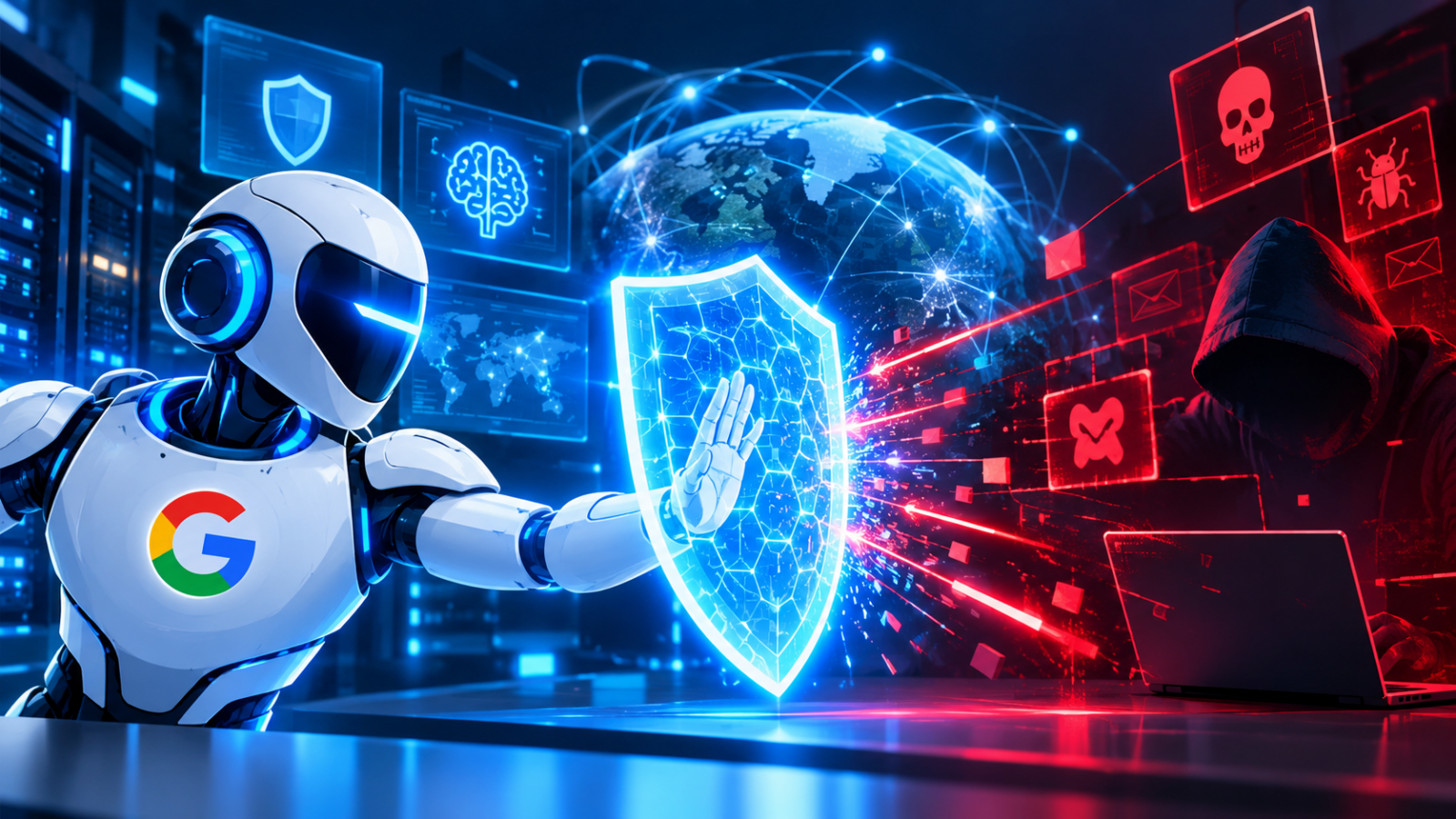
Cybersecurity is entering a new phase in 2026.
For years, security teams have relied on firewalls, antivirus software, endpoint protection, threat intelligence and human analysts to detect and stop cyberattacks. Those tools are still important, but the speed and complexity of modern attacks are creating a new challenge: security teams need to investigate and respond faster than ever.
Artificial intelligence is becoming an important part of that response.
AI agents can now help security teams investigate alerts, search for vulnerabilities, analyze suspicious activity and automate parts of incident response. At the same time, cybercriminals are also using AI to make their attacks faster and more scalable.
That has created a new cybersecurity race: AI versus AI.
What Are AI Agents in Cybersecurity?
An AI agent is different from a traditional chatbot.
A chatbot generally responds to a question. An AI agent can be designed to observe information, reason about a task, use connected tools and take actions with limited human intervention.
In cybersecurity, this could mean an agent receives a suspicious security alert, gathers related information, investigates the activity and recommends or performs an appropriate response.
Microsoft describes agentic AI in cybersecurity as the use of autonomous agents to detect, investigate and respond to threats with minimal human intervention.
The goal isn’t necessarily to remove humans from cybersecurity. Instead, AI agents can take over repetitive and time-consuming work so security professionals can focus on more complex decisions.
Why Cybersecurity Needs AI in 2026
Modern organizations generate enormous amounts of security data.
Every login, email, cloud activity, application event and network connection can create signals that security teams may need to analyze.
A human team cannot manually investigate every signal.
AI can help identify patterns across large amounts of information and prioritize events that deserve attention.
This becomes particularly important when attackers are also using automation.
Google Threat Intelligence reported in September 2026 that it had observed threat actors moving from basic AI prompting toward agentic workflows and AI-enabled automation. In one case, attackers compromised a cloud resource and then used an agent-enabled workflow to plan and execute a large credential-harvesting campaign in less than six hours.
The defensive side therefore needs to become faster too.
How AI Agents Can Fight Hackers
AI agents can assist cybersecurity teams in several important areas.
1. Detecting Suspicious Activity
Security systems produce huge numbers of alerts.
An AI agent can help analyze those alerts and identify connections between events that might look unrelated at first.
For example, a suspicious login followed by unusual file access and an unexpected administrator action could form part of a larger attack.
Instead of investigating every event separately, an AI system can help security analysts understand the bigger picture.
2. Investigating Security Incidents
Incident investigation can take hours or even longer when analysts have to collect information manually.
An AI agent can help gather relevant logs, examine indicators and summarize what happened.
This can reduce the amount of repetitive investigation work.
The human security analyst can then review the findings and decide what action should be taken.
3. Finding Software Vulnerabilities
AI is also being used to discover security weaknesses before criminals can exploit them.
Google’s Product Security team developed an internal AI agent called PageBreak to help scale vulnerability discovery across Google’s first-party web applications. Google says the project began as a pilot in late 2025 and became a larger project in January 2026.
Microsoft has also reported using an agentic security system to discover vulnerabilities. In May 2026, Microsoft said its system helped researchers identify 16 vulnerabilities in Windows networking and authentication components, including four critical remote-code-execution flaws.
These examples show why AI-assisted security research is becoming an important area of cybersecurity.
4. Faster Threat Response
Finding an attack is only part of the problem.
Security teams also need to respond.
An AI-powered system can help prioritize incidents, investigate affected systems and recommend containment steps.
Microsoft’s Project Perception, announced in 2026, uses specialized security agents designed to work together across different security tasks. Microsoft describes red-team agents for finding weaknesses, blue-team agents for investigating threats and green-team agents for helping remediate discovered problems.
This approach moves cybersecurity toward more continuous and automated defense.
5. AI Can Help Security Teams Work Around the Clock
Cyberattacks don’t follow office hours.
A security team may have limited staff available at night or during weekends, while automated attacks can continue running.
AI agents can continuously monitor security signals and help identify suspicious behavior.
This doesn’t mean organizations should allow an AI system to make every security decision automatically. High-impact actions still require appropriate controls, permissions and human oversight.
But continuous AI-assisted monitoring can reduce the time between detection and investigation.
The Problem: Hackers Are Using AI Too
The cybersecurity story isn’t simply about defenders getting better tools.
Attackers are also adopting AI.
Google Threat Intelligence has reported that threat actors are increasingly using AI to support vulnerability exploitation, initial access and other parts of cyber operations.
Google also reported that attackers are moving toward more autonomous AI workflows.
This creates a difficult situation.
If an attacker can automate parts of a campaign while defenders still investigate everything manually, the attacker may gain a significant speed advantage.
That is why security teams are increasingly interested in agentic defense.
AI Agents Also Create New Security Risks
There is an important catch.
The same capabilities that make AI agents useful can also make them dangerous if they are poorly secured.
An AI agent may have permission to:
- Access company files
- Read emails
- Query databases
- Use APIs
- Run software tools
- Modify information
- Trigger business workflows
If an attacker manipulates an agent, those permissions could potentially be abused.
Google Cloud describes AI agents as a new type of security challenge because they can move beyond simply retrieving information and take actions using connected systems.
This is why organizations need strong identity controls, limited permissions, monitoring and clear policies around what an agent can do.
Prompt Injection Is Becoming More Important
One emerging concern is prompt injection.
A prompt injection attack attempts to manipulate an AI system into ignoring its intended instructions and following malicious instructions instead.
For example, an attacker could place malicious instructions inside content that an AI agent is processing.
If the agent has access to sensitive information or powerful tools, the consequences could be serious.
Google’s cybersecurity forecasting for 2026 identified prompt injection as a growing threat as organizations increasingly deploy AI systems and agents.
This is one reason AI security cannot simply focus on the model itself. The tools, permissions, data and environment surrounding the model also need protection.
Google Is Building Specialized Cybersecurity AI
Google is also developing AI specifically for cybersecurity.
At I/O Connect India 2026, Google announced Sec-Gemini v3, a specialized cybersecurity agent being made available to trusted government and enterprise testers, including Flipkart. Google also highlighted work around secure runtime environments and standards for agent interactions.
The idea is to combine AI capabilities with cybersecurity knowledge so security professionals can investigate threats more efficiently.
This represents a broader industry trend: instead of using general-purpose AI for everything, organizations are developing specialized AI systems for security tasks.
The Future of Cybersecurity May Be Human + AI
It is tempting to imagine a future where AI completely replaces cybersecurity professionals.
That is unlikely to be the best model.
Cybersecurity involves uncertainty, business risk, legal considerations and decisions that can have major consequences.
An AI agent might identify suspicious behavior, but a human may still need to decide whether shutting down a production server is worth the potential business disruption.
The strongest approach is likely to combine AI speed with human judgment.
AI can handle large-scale analysis and repetitive tasks.
Humans can provide oversight, context and accountability.
How Businesses Can Prepare for AI-Powered Cybersecurity
Businesses adopting AI agents should think about security from the beginning.
Some important practices include:
Give Agents Only the Access They Need
An AI agent should not automatically have administrator-level access to every system.
Permissions should be limited to what the agent actually requires.
Monitor Agent Activity
Organizations should know which agents exist, what systems they can access and what actions they perform.
Keep Humans in the Loop
High-risk actions should require approval or additional controls.
Test AI Systems Against Attacks
Security teams should actively test agents for prompt injection, data leakage, unauthorized actions and other weaknesses.
Build Security Into the Architecture
Security should not be added after an AI system is deployed.
Google’s guidance for India’s agentic future emphasizes building safety into the architecture from the beginning because autonomous software can interpret intent, use tools and take actions.
AI vs Hackers: What Happens Next?
The cybersecurity industry is entering an unusual period where both attackers and defenders have access to increasingly capable AI.
Attackers can potentially automate reconnaissance, vulnerability research and other activities.
Defenders can use AI agents to analyze security data, discover vulnerabilities, investigate incidents and respond faster.
This could make cybersecurity more automated than ever before.
But AI isn’t a magic shield.
Poorly configured AI agents can introduce new risks, and automated systems can make mistakes. Organizations therefore need strong governance, monitoring, access controls and human oversight.
Final Thoughts
AI-powered cybersecurity is becoming one of the most important technology trends of 2026.
AI agents are helping security teams move from manually investigating every alert toward faster, more automated defense. Google, Microsoft and other major technology companies are investing heavily in agentic cybersecurity systems and specialized security AI.
At the same time, attackers are adopting AI, creating a race between automated attacks and automated defense.
The future of cybersecurity will probably not be AI versus humans.
It will be humans working with AI against increasingly automated threats.
The organizations that combine powerful AI with strong security controls, responsible governance and experienced cybersecurity professionals will be better positioned for the next generation of cyber threats.