


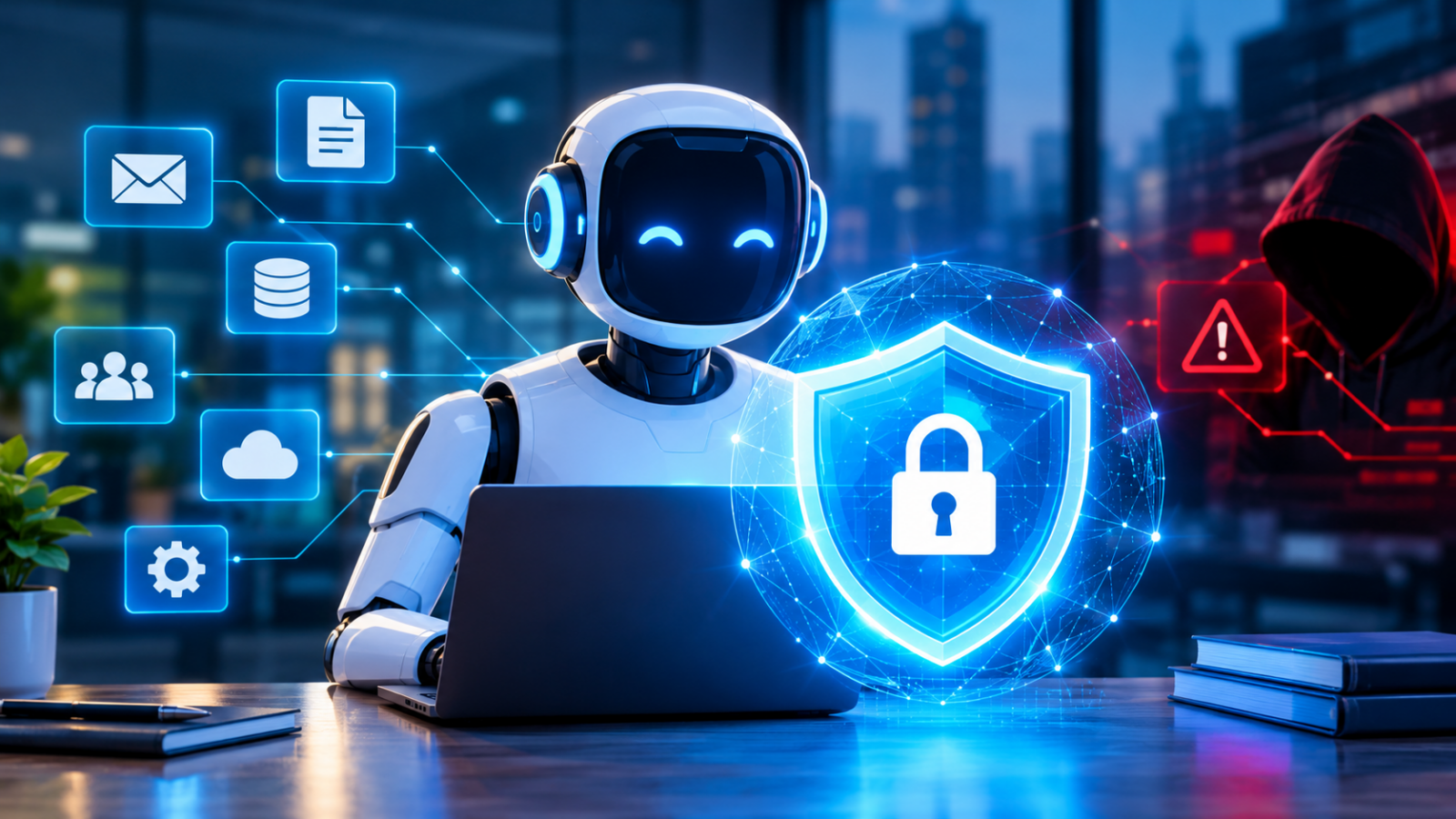
Artificial intelligence is changing the way businesses work. From answering customer questions to writing code and managing daily tasks, AI tools are becoming more powerful every year. In 2026, one of the biggest developments is the rise of AI agents that can perform tasks with limited human supervision.
However, this progress also brings new cybersecurity challenges. AI agents may interact with company files, emails, business applications, databases, and other digital systems. If they receive excessive permissions or are manipulated by malicious instructions, sensitive information could be exposed.
Understanding AI agent security risks is becoming increasingly important for businesses, developers, and everyday technology users.
What Are AI Agents?
AI agents are artificial intelligence systems designed to complete tasks rather than simply respond to questions. Depending on their capabilities, they can plan activities, use digital tools, retrieve information, and perform actions on behalf of a user.
For example, an AI agent might:
- Read emails and prepare replies.
- Search documents and summarize reports.
- Update customer information in a business system.
- Analyse data and generate reports.
- Assist developers with testing and debugging software.
- Organize meetings and manage routine administrative tasks.
Unlike a basic chatbot, an AI agent may be connected to external tools and authorized to take action. This makes it useful for productivity, but it also increases the importance of controlling what the system can access and change.
Why Are AI Agent Security Risks Growing in 2026?
The growing adoption of AI agents creates a different type of cybersecurity challenge. Traditional software generally follows predefined rules, while AI systems can interpret instructions and generate responses based on context.
When AI agents are connected to business tools, the potential consequences of a mistake become more serious.
Here are some important risks businesses should understand.
1. Unauthorized Access to Confidential Data
AI agents may need access to documents, customer records, emails, or internal databases to complete their tasks.
If an agent receives broader permissions than necessary, it could access information unrelated to its assigned work. A poorly configured system might also expose confidential information through generated responses, reports, or connected applications.
For businesses, exposed information could include customer details, financial documents, internal communications, and intellectual property.
How to reduce the risk: Give each AI agent access only to the information required for its specific task. Review permissions regularly and remove access that is no longer necessary.
2. Prompt Injection Attacks
Prompt injection is an emerging security concern for AI systems that process external content.
An attacker may place malicious instructions inside a webpage, email, document, or other material an AI agent reads. If the agent fails to distinguish untrusted content from authorized instructions, it may be manipulated into taking unintended actions.
For example, an AI assistant reviewing an email could encounter hidden or misleading instructions designed to influence its behaviour.
The danger increases when the agent can access confidential files or perform actions through connected tools.
How to reduce the risk: Treat emails, webpages, uploaded documents, and external messages as untrusted inputs. Use permission controls, separate sensitive operations from ordinary reading tasks, and require human approval for high-impact actions.
3. Data Leaks Through Connected AI Tools
Many AI agents work with third-party applications, including cloud storage, customer relationship management systems, and productivity software.
Every additional connection creates another area that must be secured. Incorrect settings, insecure integrations, or excessive permissions can increase the possibility of data exposure.
Employees may also submit sensitive business information to AI services without understanding the organization’s data-handling policies.
How to reduce the risk: Approve AI integrations centrally, review the information each service can access, and establish clear rules about uploading confidential information. Check the provider’s data-retention and privacy policies before connecting business systems.
4. AI Agents Taking Actions Without Proper Approval
An AI agent may be able to send emails, update records, delete files, or make changes to business applications.
If the agent misunderstands a request or follows malicious instructions, an action that should have been harmless could create a serious problem.
For example, an automated assistant might send an incomplete email to a customer or change important information in a business database.
The risk is greater when an agent can perform irreversible actions without additional checks.
How to reduce the risk: Require human confirmation before sending external communications, deleting important information, transferring money, changing access permissions, or making other sensitive modifications.
5. Stolen Credentials and API Keys
AI agents often rely on credentials, access tokens, or API keys to communicate with external services.
If these secrets are stored insecurely or accidentally included in logs, configuration files, or shared documents, attackers could potentially misuse them.
A compromised credential might allow access to business applications even when the AI model itself has not been hacked.
How to reduce the risk: Store secrets in a secure credential manager, rotate them regularly, limit their permissions, and monitor unusual access. Never place passwords or API keys directly into public code repositories.
How Can Businesses Protect Themselves From AI Security Threats?
Companies do not need to stop using AI agents to improve security. Instead, they should introduce appropriate safeguards before allowing agents to handle sensitive information or perform important tasks.
Apply the Principle of Least Privilege
Every AI agent should receive the minimum access necessary to complete its assigned responsibilities.
An agent that summarizes public information does not need access to payroll records or confidential customer databases. Limiting permissions can reduce the damage caused by errors or misuse.
Keep Humans Involved in Important Decisions
Automation can save time, but not every task should be completed without supervision.
Businesses should create approval steps for sensitive actions, particularly those involving financial transactions, confidential information, account permissions, or external communications.
Monitor AI Activity
Organizations should maintain appropriate logs of important AI actions, including which systems were accessed, what changes were made, and whether sensitive operations required approval.
Monitoring helps security teams investigate unexpected behaviour and identify problems before they become larger incidents.
Test AI Systems Before Deployment
Businesses should evaluate AI agents in controlled environments before giving them access to production systems.
Testing should include misleading instructions, unauthorized access attempts, unusual user requests, and scenarios involving confidential data.
Security testing should continue after deployment because AI applications, integrations, and permissions can change over time.
Establish a Clear AI Usage Policy
Employees need practical guidance on how to use AI tools safely.
A useful policy should explain which tools are approved, what information can be shared, which actions require authorization, and how employees should report suspicious activity.
Regular training can help workers recognize risks without discouraging responsible AI adoption.
Are AI Agents Safe for Small Businesses?
AI agents can be useful for small businesses that want to automate repetitive work without hiring additional staff. They can help with customer support, content organization, research, reporting, and routine administration.
However, smaller organizations may not have dedicated cybersecurity teams to manage complex integrations.
The best approach is to begin with low-risk tasks and expand gradually.
For example, a small business could first use an AI agent to summarize non-confidential documents. After testing its reliability and security, the company could consider connecting it to selected business applications with restricted permissions.
Businesses should avoid giving new AI tools unrestricted access to email accounts, financial systems, or customer databases simply because an integration is convenient.
Security should be part of the setup process, not something added after a problem occurs.
Will AI Agents Replace Traditional Cybersecurity Tools?
AI agents may help security teams investigate alerts, summarize incident reports, identify suspicious activity, and automate selected defensive tasks.
However, they are not a replacement for established cybersecurity controls.
Firewalls, multi-factor authentication, endpoint protection, access management, secure backups, and regular software updates remain important. AI can support these measures, but it can also introduce new risks if deployed without appropriate safeguards.
The strongest approach combines AI-assisted security with established technical controls and human oversight.
What Should Users Know About AI Agent Privacy?
Individual users should also think carefully about the permissions they grant AI assistants.
Before connecting an AI tool to your email, cloud storage, calendar, or work account, consider the following questions:
- Does the tool genuinely need access to all these files?
- Can you restrict access to a specific folder or account?
- What happens to the information you share?
- Can the agent send messages or modify files automatically?
- Can you review and revoke its permissions later?
Avoid connecting unfamiliar AI applications to important accounts until you understand their permissions and privacy practices.
A few minutes spent reviewing settings can help prevent unnecessary exposure.
The Future of AI Agent Security
AI agents are likely to become more capable as businesses adopt systems that can coordinate multiple applications and complete longer tasks.
This could improve productivity across industries, but it also means that access controls, monitoring, and responsible automation will become increasingly important.
Developers will need to design systems that handle untrusted instructions safely. Businesses will need to review permissions and test their AI integrations. Users will need to understand what their digital assistants can access and do.
The goal is not to eliminate AI automation. It is to make sure that the benefits of automation do not come at the expense of security and privacy.
Conclusion
AI agent security risks are an important consideration as artificial intelligence moves beyond conversations and begins performing real tasks.
Unauthorized data access, prompt injection, insecure integrations, stolen credentials, and unsupervised actions are all issues organizations should consider when deploying AI agents.
Businesses can reduce these risks by limiting permissions, monitoring activity, testing systems, protecting credentials, and requiring human approval for sensitive operations.
AI agents offer significant opportunities for productivity and innovation. With sensible security practices, organizations can take advantage of these tools while making better decisions about protecting their data.
As AI becomes more capable, responsible access management and human oversight will be essential to building trust in the next generation of intelligent technology.