
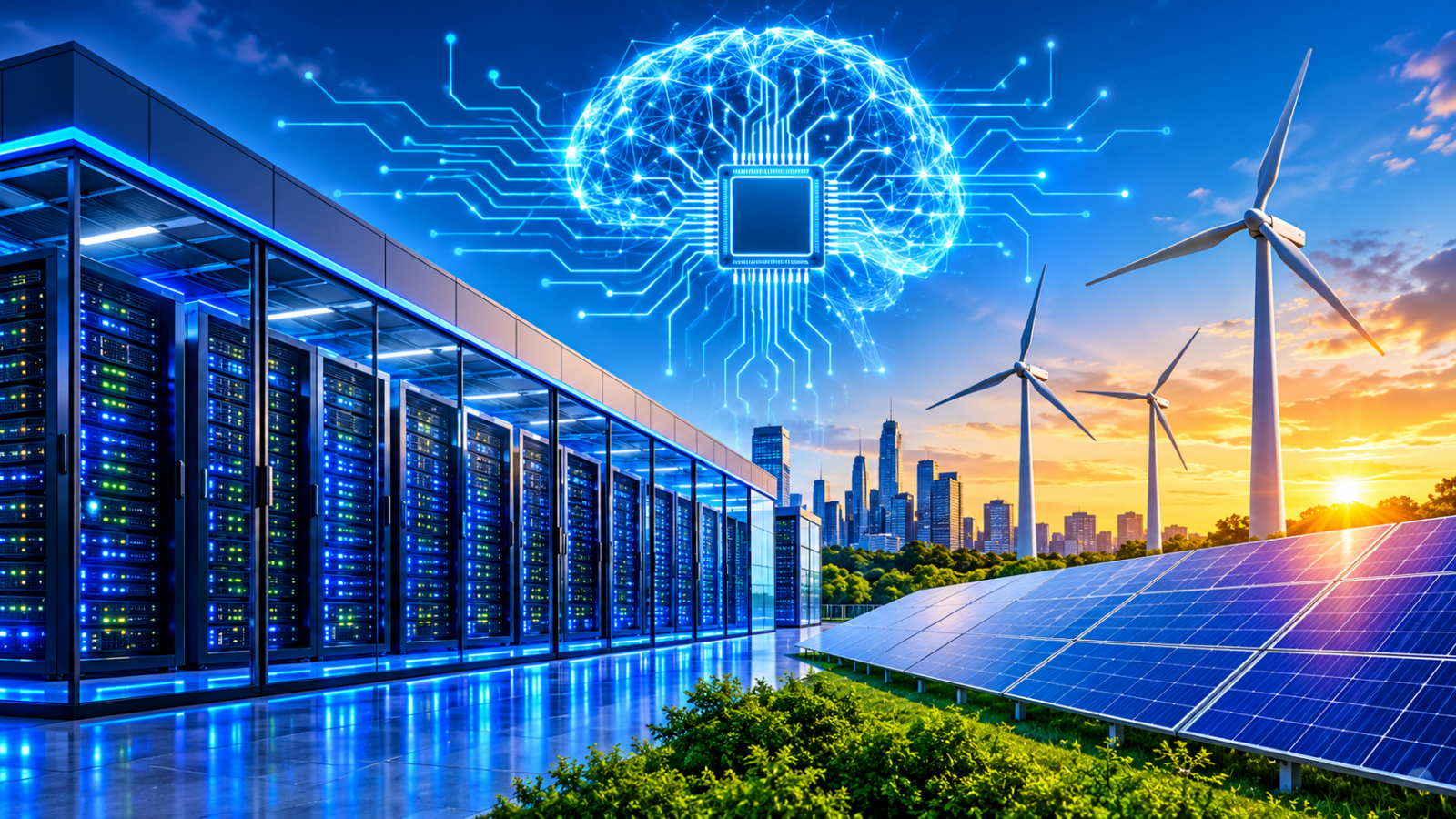
AI data center energy consumption is becoming one of the biggest challenges in the rapidly growing artificial intelligence industry. As AI technology advances, companies such as Google, Microsoft, Amazon, and OpenAI are investing heavily in powerful data centers that require enormous amounts of electricity.
From AI chatbots and image generators to self-driving cars and smart business tools, millions of people now use artificial intelligence in their everyday lives. However, behind every AI-generated answer, image, or video, there is a massive computing infrastructure that needs continuous electricity.
The growing demand for AI computing is raising important questions about energy costs, renewable power, environmental impact, and the future of technology.
In this article, we explore why AI data center energy consumption is increasing, how major technology companies are responding, and what this means for the future of artificial intelligence.
What Are AI Data Centers?
A data center is a specialized facility that stores, processes, and manages digital information. It contains powerful computers, networking equipment, storage systems, and cooling infrastructure.
Traditional data centers support services such as websites, cloud storage, online banking, video streaming, and business applications.
AI data centers are designed to handle much more demanding workloads. They use powerful graphics processing units (GPUs), specialized AI accelerators, and advanced computing systems to train and operate artificial intelligence models.
For example, when someone asks an AI chatbot a question, the request is processed by powerful computers inside data centers. The same infrastructure supports AI image generation, video creation, voice assistants, and advanced business automation.
Unlike ordinary computing tasks, training and running large AI models can require significant computing power. This is one of the main reasons electricity demand is increasing.
Why Are AI Data Centers Consuming So Much Electricity?
There isn’t just one reason behind the growing energy consumption of AI infrastructure. Several technological developments are contributing to the problem.
1. Powerful AI Chips Require More Energy
Modern artificial intelligence systems depend on powerful processors to perform billions of calculations.
Companies are investing in advanced GPUs and AI accelerators to train larger models and deliver faster responses. These chips are designed for demanding workloads, but they also consume substantial amounts of electricity.
When thousands of processors operate together inside a large data center, their combined energy requirements become significant.
As AI models become more sophisticated, companies need additional computing resources to support them.
2. AI Training Requires Massive Computing Power
Training an AI model is a complex process.
An AI system learns patterns from large datasets through repeated calculations. This process can involve millions or billions of operations, depending on the model’s size and complexity.
Large language models, image-generation systems, and advanced AI platforms require powerful computing infrastructure.
Training is only part of the story. Once an AI model becomes available to the public, it must continue processing requests from users around the world.
This ongoing process is known as AI inference.
With more people using AI applications every day, inference workloads are becoming another important source of electricity demand.
3. Data Centers Need Powerful Cooling Systems
Electricity consumption does not come only from computers.
Powerful processors generate heat when operating continuously. If the temperature becomes too high, hardware performance can decrease, and equipment may become damaged.
To prevent this, data centers use advanced cooling technologies, including:
-
Air-conditioning and industrial cooling systems.
-
Liquid cooling technology.
-
Direct-to-chip cooling.
-
Advanced airflow management.
-
Temperature monitoring systems.
Some modern AI facilities are exploring liquid cooling because it can help manage the heat produced by high-performance computing equipment.
However, cooling systems also require energy and infrastructure, increasing the overall cost of operating data centers.
4. Growing Demand for AI Applications
AI is no longer limited to technology companies.
Businesses, educational institutions, healthcare organizations, financial services, and content creators are adopting AI-powered tools.
Popular applications include:
-
AI chatbots and virtual assistants.
-
AI-powered search engines.
-
Automatic video and image generation.
-
Voice recognition and translation.
-
AI coding assistants.
-
Business automation tools.
-
Autonomous vehicles and robotics.
As these services become more popular, companies need more computing capacity to handle user requests.
The result is increasing pressure on data center infrastructure and electricity networks.
How Much Electricity Do Data Centers Actually Use?
Data centers already consume a significant amount of electricity worldwide, and the expansion of artificial intelligence is expected to increase their energy requirements.
According to the International Energy Agency (IEA), global data center electricity consumption was approximately 415 terawatt-hours (TWh) in 2024, representing around 1.5% of worldwide electricity consumption.
The IEA has also projected that global data center electricity demand could more than double by 2030, reaching approximately 945 TWh.
This growth is being driven by several factors, including AI computing, cloud services, digital businesses, and increasing internet usage.
However, it is important to understand that not all data center electricity consumption comes from AI. Traditional cloud computing, online services, storage, and other digital activities also contribute to total demand.
How Big Technology Companies Are Responding
The world’s biggest technology companies are investing billions of dollars in data centers and AI infrastructure.
Here are some of the major players shaping this industry.
1. Google Is Investing in AI Infrastructure
Google is expanding its AI capabilities through cloud computing, advanced processors, and large-scale data centers.
Its AI services, including Gemini, require powerful computing infrastructure to train models and respond to user requests.
Google is also working on improving data center efficiency through better cooling systems, hardware optimization, and clean energy investments.
2. Microsoft Is Expanding Its AI Data Centers
Microsoft is investing heavily in cloud infrastructure to support Azure, Copilot, and other AI-powered services.
As demand for AI computing increases, Microsoft needs additional servers, networking equipment, and electricity capacity.
The company has also made commitments to renewable energy and carbon reduction, highlighting the importance of balancing technological growth with environmental responsibility.
3. Amazon Is Increasing Cloud Computing Capacity
Amazon Web Services provides computing infrastructure to businesses, developers, and AI companies around the world.
Its cloud infrastructure supports machine learning, generative AI, data processing, and enterprise applications.
As more businesses move their operations to the cloud and adopt AI tools, demand for AWS computing resources continues to create opportunities for infrastructure expansion.
4. Nvidia Is Powering the AI Revolution
Nvidia has become one of the most important companies in the AI infrastructure market.
Its GPUs and computing platforms are widely used to train and operate advanced AI models.
Although Nvidia does not operate every data center that uses its technology, its hardware plays a major role in the growing demand for AI computing power.
How AI Electricity Demand Could Affect Everyday People
The expansion of AI infrastructure is not just a concern for technology companies. It could also influence everyday life.
Here are some possible effects.
1. Electricity Prices Could Face More Pressure
As data centers expand, they may increase electricity demand in areas where power infrastructure is already under pressure.
If electricity supply does not grow at the same pace, local electricity prices could face upward pressure.
The actual impact will depend on regional energy production, grid capacity, government policies, and how new data centers are connected to electricity networks.
2. Technology Companies May Increase AI Service Costs
Running advanced AI models requires expensive hardware, electricity, cooling, and maintenance.
These operating costs could influence the pricing of AI subscriptions and cloud computing services.
Some AI tools may become more expensive, while others may focus on improving efficiency to offer affordable services.
3. More Investment in Renewable Energy
The growing electricity demand could encourage technology companies to invest more in solar, wind, nuclear, and other low-carbon energy sources.
This could create new opportunities for renewable energy businesses and encourage innovation in electricity storage.
4. More Pressure on Local Power Infrastructure
Large data centers need reliable electricity around the clock.
This can require new power transmission lines, substations, and grid improvements.
Communities near major data center projects may also raise concerns about electricity availability, water usage, noise, and environmental impact.
Can Renewable Energy Solve the AI Electricity Problem?
Renewable energy could play an important role in supporting the future growth of artificial intelligence.
Solar and wind power offer alternatives to electricity generated from fossil fuels. Technology companies are increasingly exploring long-term clean energy agreements to support their operations.
However, renewable energy also comes with challenges.
Solar power depends on sunlight, while wind power depends on weather conditions. Both sources can produce electricity inconsistently throughout the day.
This is why energy storage technology is becoming increasingly important.
Large battery storage systems can store excess electricity and release it when renewable energy production decreases.
Other possible solutions include:
-
Solar power: Generating clean electricity for data center operations.
-
Wind energy: Providing additional renewable electricity.
-
Nuclear energy: Offering consistent low-carbon electricity generation.
-
Battery storage: Helping balance electricity supply and demand.
-
Smart electricity grids: Improving how power is distributed.
-
Advanced energy management: Reducing unnecessary electricity consumption.
A combination of these technologies could help meet future electricity demand while reducing environmental impact.
New Technologies That Could Make AI Data Centers More Energy Efficient
The future of artificial intelligence does not necessarily mean unlimited electricity consumption.
Technology companies and researchers are developing solutions to make AI computing more efficient.
Some of the most promising developments include:
1. More Efficient AI Chips
Future AI processors may deliver better performance while using less electricity.
Improved chip architecture, advanced manufacturing processes, and specialized AI accelerators could reduce the energy required for certain computing tasks.
2. Smaller and More Efficient AI Models
Not every AI application needs an extremely large model.
Smaller AI models can perform specific tasks with fewer computing resources. Businesses may increasingly use specialized models for customer support, document processing, coding, and other applications.
This could reduce the cost and electricity required for everyday AI services.
3. Advanced Liquid Cooling
Liquid cooling can help remove heat more effectively from high-performance processors.
By improving thermal management, data center operators may be able to support powerful hardware more efficiently.
4. AI-Powered Energy Management
Interestingly, artificial intelligence itself could help reduce energy consumption.
AI-powered monitoring systems can analyze temperature, electricity usage, server performance, and cooling requirements.
These systems can identify inefficient operations and adjust infrastructure automatically.
This creates an interesting opportunity: AI could help solve some of the energy challenges created by AI.
What Does This Mean for the Future of Artificial Intelligence?
Artificial intelligence is expected to become part of almost every industry. From education and healthcare to transportation, manufacturing, and entertainment, AI technology is opening new possibilities.
However, its future growth will depend on more than powerful computer chips and advanced software.
Companies will also need reliable electricity, efficient cooling systems, sustainable infrastructure, and better energy management.
In the coming years, we may see a major shift in how technology companies design and operate data centers.
Instead of focusing only on building larger computing facilities, businesses may increasingly compete to develop AI systems that deliver better results with fewer resources.
This could make energy efficiency one of the most important areas of innovation in the technology industry.
Challenges the Technology Industry Must Overcome
Despite rapid progress, several challenges remain:
-
Electricity availability: Power infrastructure must keep up with increasing data center demand.
-
Environmental impact: Companies need to reduce carbon emissions associated with computing.
-
Water consumption: Some cooling technologies require significant amounts of water.
-
Infrastructure costs: Building and maintaining advanced data centers requires major investment.
-
Energy efficiency: Future AI systems must deliver better performance without continuously increasing power consumption.
Solving these challenges will require cooperation between technology companies, energy providers, governments, and researchers.
Conclusion: The Future of AI Depends on More Than Computing Power
Artificial intelligence is transforming the technology industry, but its rapid expansion is creating a new challenge that cannot be ignored: energy consumption.
As AI tools become more advanced and widely used, data centers will need more electricity to train models, process information, and support millions of users.
Technology companies are already exploring renewable energy, advanced cooling, efficient processors, and smarter infrastructure to address this challenge.
The next stage of the AI revolution may not simply be about creating the biggest or smartest AI model. It could be about developing powerful artificial intelligence that uses less energy and operates more sustainably.
The future of AI will depend not only on how intelligent machines become, but also on how efficiently we can power them.
Frequently Asked Questions (FAQs)
1. Why do AI data centers consume so much electricity?
AI data centers use powerful GPUs, specialized processors, and large server networks to train and operate artificial intelligence models. These systems also require cooling infrastructure to prevent overheating.
2. How much electricity do data centers consume worldwide?
According to the International Energy Agency, data centers consumed approximately 415 TWh of electricity worldwide in 2024, equivalent to around 1.5% of global electricity consumption.
3. Will AI increase electricity prices?
AI infrastructure could increase electricity demand in certain regions, potentially putting pressure on local electricity prices. The actual impact depends on electricity supply, grid capacity, and infrastructure investment.
4. Can renewable energy power AI data centers?
Yes. Solar, wind, nuclear, and other low-carbon energy sources can help support data center operations. Battery storage and improved electricity grids can also help manage energy availability.
5. Which companies are investing in AI data centers?
Major technology companies investing in AI infrastructure include Google, Microsoft, Amazon, Meta, and other cloud computing and technology providers.
6. Will AI become more energy efficient in the future?
AI could become more energy efficient through improved processors, smaller AI models, advanced cooling technologies, and better computing infrastructure.