
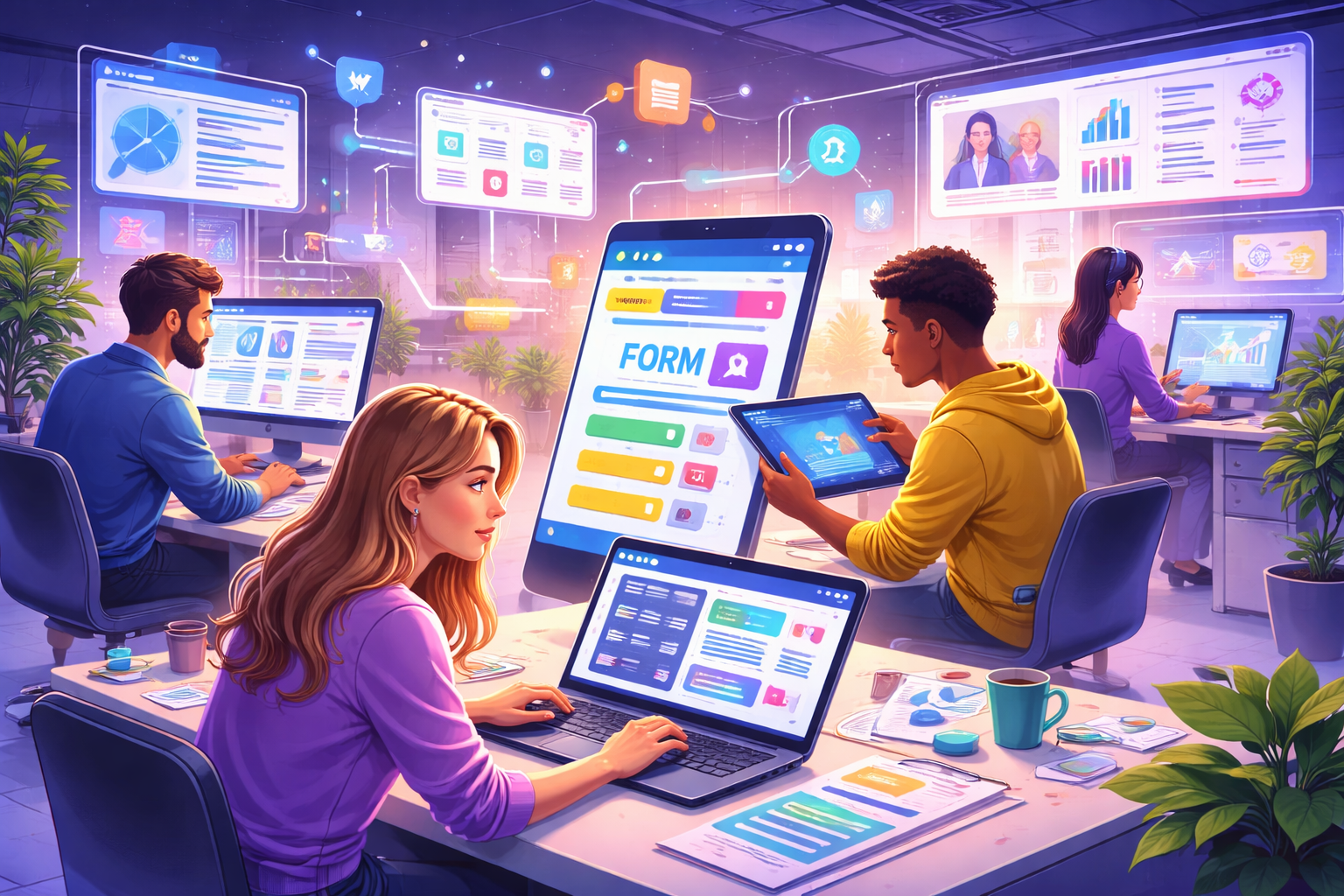
In today’s fast-moving digital world, businesses and creators need apps, tools, and websites faster than ever. But traditional coding — often complex and time-consuming — can’t always keep up. That’s where the Low-Code/No-Code (LCNC) revolution steps in, changing how digital products are built in 2026 and beyond.
This quiet revolution is making software creation accessible to everyone, from entrepreneurs and designers to marketing teams and small businesses. The promise is simple yet powerful: build without coding expertise.
What Is Low-Code/No-Code Development?
Low-Code and No-Code platforms are digital builders that use drag-and-drop interfaces, visual workflows, and pre-built logic blocks to create applications.
Low-Code tools still require some coding knowledge but automate most of the repetitive work.
No-Code tools are designed for complete beginners, enabling users to build apps purely through visual design.
Popular platforms like Bubble, OutSystems, AppSheet, and Webflow are leading this shift, giving rise to a new generation of “citizen developers” — individuals who can create solutions without traditional programming backgrounds.
Why 2026 Is the Turning Point
In 2026, Low-Code/No-Code development isn’t just a trend — it’s becoming a core business strategy. According to recent tech industry reports, more than 65% of organizations are now adopting LCNC tools to speed up digital transformation.
This rapid adoption is fueled by several key drivers:
AI Integration: Many platforms now use AI to suggest workflows, write logic, and even design UI components automatically.
Faster Innovation: Businesses can prototype and deploy apps in days instead of months.
Cost Efficiency: Reduces the need for large developer teams and shortens project timelines.
Accessibility: Empowers non-technical teams to automate tasks and build tools themselves.
In short, LCNC tools are breaking down the walls between ideas and implementation.
The Rise of Citizen Developers
The biggest winners of this revolution are non-technical creators. Marketers can now automate campaign dashboards, HR teams can create onboarding portals, and small business owners can launch custom apps — all without writing a single line of code.
These platforms also encourage collaboration. Developers and non-developers can now work side by side, blending technical precision with business insight. This collaboration is reshaping how digital products are designed, tested, and launched.
Challenges on the Horizon
Of course, the LCNC boom brings new challenges. Security, scalability, and platform dependency remain key concerns. Overreliance on third-party tools can make complex customizations harder. As the ecosystem matures, organizations must balance convenience with technical control and data privacy.
The Future: Creativity Over Code
The Low-Code/No-Code revolution isn’t about replacing developers — it’s about freeing them. By automating repetitive coding tasks, developers can focus on innovation, strategy, and complex systems, while non-technical users take care of simpler workflows.
In 2026 and beyond, digital creation will no longer be limited to programmers. The power to build will rest in everyone’s hands — marking the true beginning of a code-free creative era.