
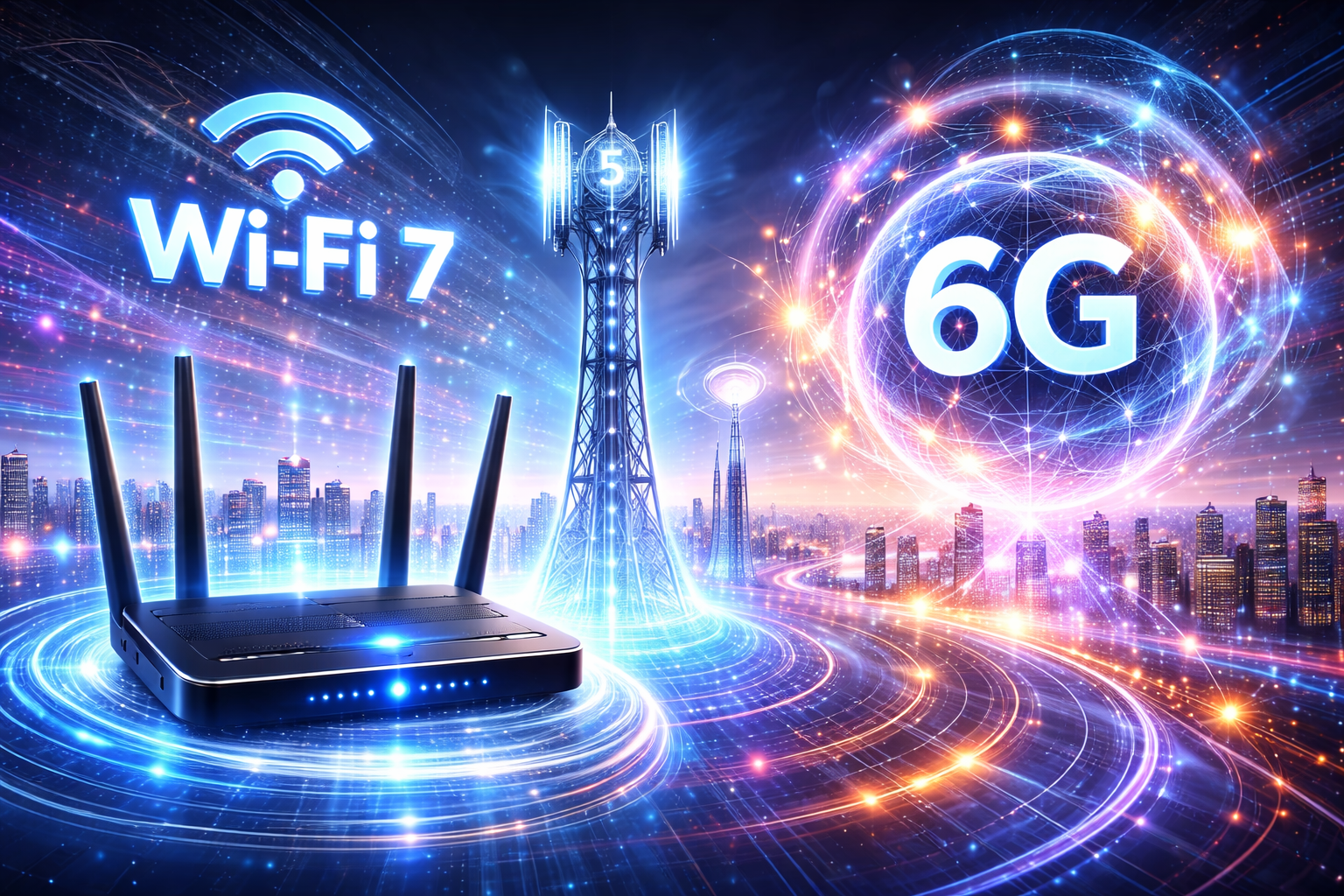
In a world driven by digital experiences, connectivity has become as essential as electricity. Every leap in wireless technology—from 3G to 4G to 5G—has changed how we work, stream, and communicate. Now, as Wi-Fi 7, 5G-Advanced, and even the foundations of 6G emerge, the next era of ultra-fast, low-latency networks is already taking shape.
These advancements won’t just mean faster downloads—they’ll enable immersive virtual realities, smart cities, autonomous systems, and real-time global collaboration.
Wi-Fi 7: The Next Leap in Local Connectivity
Wi-Fi 7, officially known as IEEE 802.11be, represents the next evolution in wireless networking. It builds upon Wi-Fi 6E’s foundation but delivers significant improvements in speed, capacity, and efficiency.
Key Features of Wi-Fi 7:
-
Blazing Speeds – Wi-Fi 7 can achieve speeds up to 46 Gbps, nearly four times faster than Wi-Fi 6.
-
Multi-Link Operation (MLO) – Devices can simultaneously connect across multiple frequency bands (2.4 GHz, 5 GHz, and 6 GHz), reducing latency and improving reliability.
-
Wider Channels (up to 320 MHz) – Wider bandwidth allows more data to flow simultaneously, ideal for AR/VR streaming and 8K video.
-
Improved Efficiency – New modulation techniques (like 4096-QAM) increase data density, letting networks serve more devices without slowing down.
With Wi-Fi 7 routers already entering the market in 2026, homes and businesses are preparing for a future of seamless, high-capacity connections that can handle smart homes, remote work, and even real-time gaming without lag.
In short, Wi-Fi 7 will make your home network as powerful as enterprise-grade internet, enabling next-level digital experiences.
5G-Advanced: The Bridge to 6G
While Wi-Fi 7 dominates indoor connectivity, 5G-Advanced is redefining the outdoor and mobile experience. It’s not a new generation but an evolution of 5G, designed to push the limits of what current networks can achieve.
According to industry leaders like Ericsson and Qualcomm, 5G-Advanced (expected to peak between 2025 and 2027) will deliver:
-
10× faster speeds than early 5G deployments.
-
Enhanced AI-driven optimization, allowing networks to adjust in real time.
-
Better coverage through intelligent antenna arrays and advanced beamforming.
-
Energy efficiency, reducing network power consumption while increasing data throughput.
But what makes 5G-Advanced truly special is its integration with AI and edge computing. This allows networks to process data closer to users, improving performance for latency-sensitive applications like autonomous driving, smart factories, and real-time telemedicine.
Imagine your car communicating with nearby vehicles in milliseconds—or a surgeon remotely performing robotic surgery with zero lag. That’s the promise of 5G-Advanced.
6G: The Future of Hyper-Connectivity
While 5G is still rolling out globally, researchers and telecom giants are already laying the groundwork for 6G, expected to launch commercially around 2030.
What 6G Could Offer:
-
Speeds up to 1 Tbps – Downloads that take seconds today will be instant tomorrow.
-
Sub-Millisecond Latency – Perfect for real-time holograms, VR conferences, and AI-driven automation.
-
Terahertz Spectrum – 6G will use frequencies in the 100 GHz to 1 THz range, allowing massive bandwidth and minimal interference.
-
Integrated Sensing & Communication – Networks will not only connect devices but also sense environments, enabling smart traffic, precision agriculture, and even health monitoring.
-
AI-Native Networks – Unlike 5G, which uses AI as a tool, 6G will embed AI directly into its architecture—making it self-optimizing and self-healing.
6G will transform the Internet of Things (IoT) into an Internet of Everything (IoE), where billions of interconnected devices communicate intelligently, predicting and responding to human needs.
The Ecosystem Behind the Evolution
Tech giants and nations are already competing to lead the next wireless revolution.
-
Samsung, Nokia, and Huawei are heavily investing in 6G R&D.
-
Japan and South Korea have announced national 6G strategies.
-
The U.S. and India are focusing on spectrum innovation and indigenous telecom infrastructure.
Collaboration between hardware makers, telecom providers, and governments will be critical to building future-ready networks.
Meanwhile, chipmakers like Qualcomm and MediaTek are developing modems that can seamlessly transition between 5G, Wi-Fi 7, and upcoming 6G frequencies—paving the way for unified connectivity.
Real-World Impact: Beyond Speed
It’s easy to focus on gigabits per second, but the true impact of next-gen connectivity lies in new possibilities it unlocks:
-
Smart Cities: Connected infrastructure can reduce traffic, monitor pollution, and optimize energy usage.
-
Healthcare: Real-time remote surgeries and wearable AI devices will become more reliable.
-
Education: Immersive virtual classrooms will make global learning borderless.
-
Entertainment: Cloud gaming, 16K streaming, and AR concerts will become mainstream.
-
Industry: Automated factories will rely on AI-powered, zero-latency networks for precise operations.
These innovations represent not just faster data—but a smarter, more connected planet.
Challenges Ahead
Of course, every revolution comes with obstacles.
-
Infrastructure Costs: Deploying 5G-Advanced and 6G requires massive investment in towers, fiber, and spectrum.
-
Energy Consumption: High-frequency networks need more power—raising sustainability concerns.
-
Security Risks: As everything connects, cyberattacks will grow more sophisticated.
Addressing these challenges will require a balance between innovation, policy, and responsibility to ensure equitable access to next-gen connectivity.
Conclusion
From Wi-Fi 7’s lightning-fast local speeds to 5G-Advanced’s intelligent mobility and 6G’s futuristic potential, the next decade will redefine digital life. Connectivity will no longer be just a utility—it will be the foundation of AI-driven living, powering everything from homes to space exploration.
The question isn’t whether these technologies will change the world—they already are. The real question is: Are we ready for the connected future?