
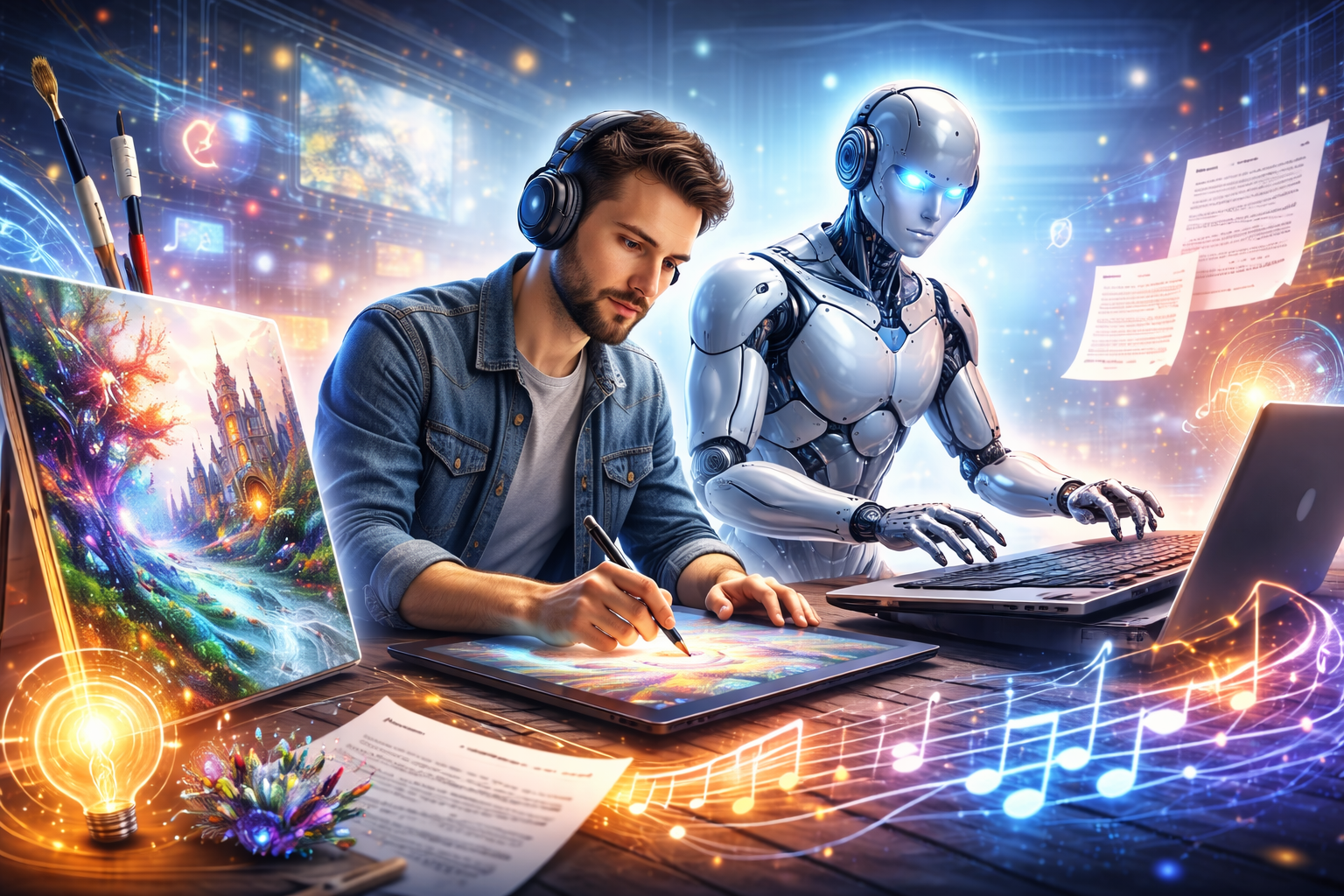
Artificial Intelligence is no longer limited to data analysis or automation—it’s now an active creator of art, music, and stories. What once required pure human imagination is increasingly shared with algorithms that learn, adapt, and produce creative works. AI-generated paintings are selling at auctions, machine-written novels are being published, and virtual composers are crafting entire soundtracks.
This rise of creative AI is not just a technological revolution; it’s a cultural shift redefining what creativity means in the 21st century.
1. The Birth of Machine Creativity
AI creativity stems from machine learning and generative models, such as Generative Adversarial Networks (GANs) and Large Language Models (LLMs). These systems analyze enormous datasets of existing works—art, music, or literature—and learn to mimic patterns, styles, and structures.
Unlike traditional software, AI doesn’t just follow instructions; it “learns” from examples. For instance:
-
DALL·E and Midjourney generate visual art from text prompts.
-
ChatGPT and Gemini produce essays, scripts, and poetry.
-
AIVA and Amper Music compose original music across genres.
The ability of machines to create unique content raises exciting possibilities—and deep philosophical questions about authorship and originality.
2. AI in Visual Art: From Canvas to Code
AI-generated art is one of the most visible forms of digital creativity. Tools like DALL·E, Stable Diffusion, and Midjourney allow users to describe a scene, and the AI paints it in seconds. The results can range from surreal dreamscapes to photo-realistic portraits.
In 2018, a Paris auction house sold a painting titled “Portrait of Edmond de Belamy” created entirely by an algorithm—for over $400,000. Since then, AI art has exploded on social media, NFT marketplaces, and galleries.
But what makes AI art unique isn’t just speed—it’s collaboration. Artists now act as curators and directors, guiding AI with creative prompts and refining outputs. This fusion of human vision and machine precision creates new artistic frontiers unimaginable a decade ago.
However, challenges remain. Critics argue that AI art borrows heavily from human artists’ work without proper attribution. This has sparked ongoing debates about copyright, ownership, and fair use in digital creativity.
3. AI in Music: When Algorithms Compose
Music is emotion in motion—and surprisingly, AI can now capture that emotion. Platforms like AIVA, Soundful, and MuseNet analyze thousands of compositions to generate melodies, harmonies, and even lyrics.
Film producers and game developers increasingly use AI-generated music for background scores, cutting down production time and costs. For example:
-
A filmmaker can input “emotional piano score for a sunset scene,” and the AI instantly creates a matching track.
-
Game studios use AI to generate adaptive music that changes with gameplay intensity.
Musicians themselves are embracing AI as a co-creator. Artists like Grimes and Taryn Southern have released AI-assisted albums, blurring the line between human emotion and computational intelligence.
Still, questions arise: Can AI truly feel rhythm or emotion? Probably not yet—but it can simulate it convincingly, opening an entirely new genre of music innovation.
4. AI in Writing: The New Creative Partner
Writing is another frontier where AI is making waves. From screenplays and marketing copy to novels and poetry, AI tools like ChatGPT, Claude, and Sudowrite assist writers in ideation, editing, and storytelling.
Authors are using AI to brainstorm plot ideas, overcome writer’s block, and even co-write stories. Some newspapers employ AI to generate real-time reports on sports and finance. Content creators rely on AI for drafting blogs, captions, and ads faster than ever before.
Yet, the real power of AI in writing isn’t replacement—it’s enhancement. By automating repetitive tasks, writers can focus on creativity and emotion. Think of AI as a digital collaborator rather than a competitor.
Still, ethical boundaries must be clear. AI can produce misinformation or plagiarism if used irresponsibly, so human supervision remains vital to preserve authenticity.
5. Ethics, Copyright, and Authenticity
As AI’s creative potential expands, so do legal and moral dilemmas:
-
Who owns AI-generated art? The user who prompted it, the company that built the model, or the AI itself?
-
What about originality? If an AI learns from millions of human-created works, where does inspiration end and imitation begin?
Global policymakers are working toward AI copyright frameworks. The European Union and the United States are drafting regulations to clarify ownership and responsibility for AI-generated works.
Transparency is key. Users must disclose when content is AI-assisted, ensuring audiences can distinguish between human art and machine art.
6. The Human–AI Creative Synergy
Despite concerns, most experts agree that AI won’t replace artists—it will empower them. The relationship between human and AI creativity is like that between a painter and their brush: the tool amplifies expression but doesn’t define it.
Future creators will likely use AI as a creative amplifier—a partner that expands imagination, automates technical tasks, and accelerates ideation. In fact, many believe the most profound art of the future will come from human–AI collaboration, not competition.
Conclusion
AI-generated creativity marks a new era of expression where machines don’t just compute—they create. Whether painting, composing, or writing, AI is reshaping the boundaries of imagination itself.
But the magic lies in collaboration. The best outcomes happen when human emotion meets machine intelligence, crafting art that’s both innovative and deeply personal.
In the coming years, creativity will not be about human vs. machine—but about how both can inspire each other to create a more expressive, interconnected world.