
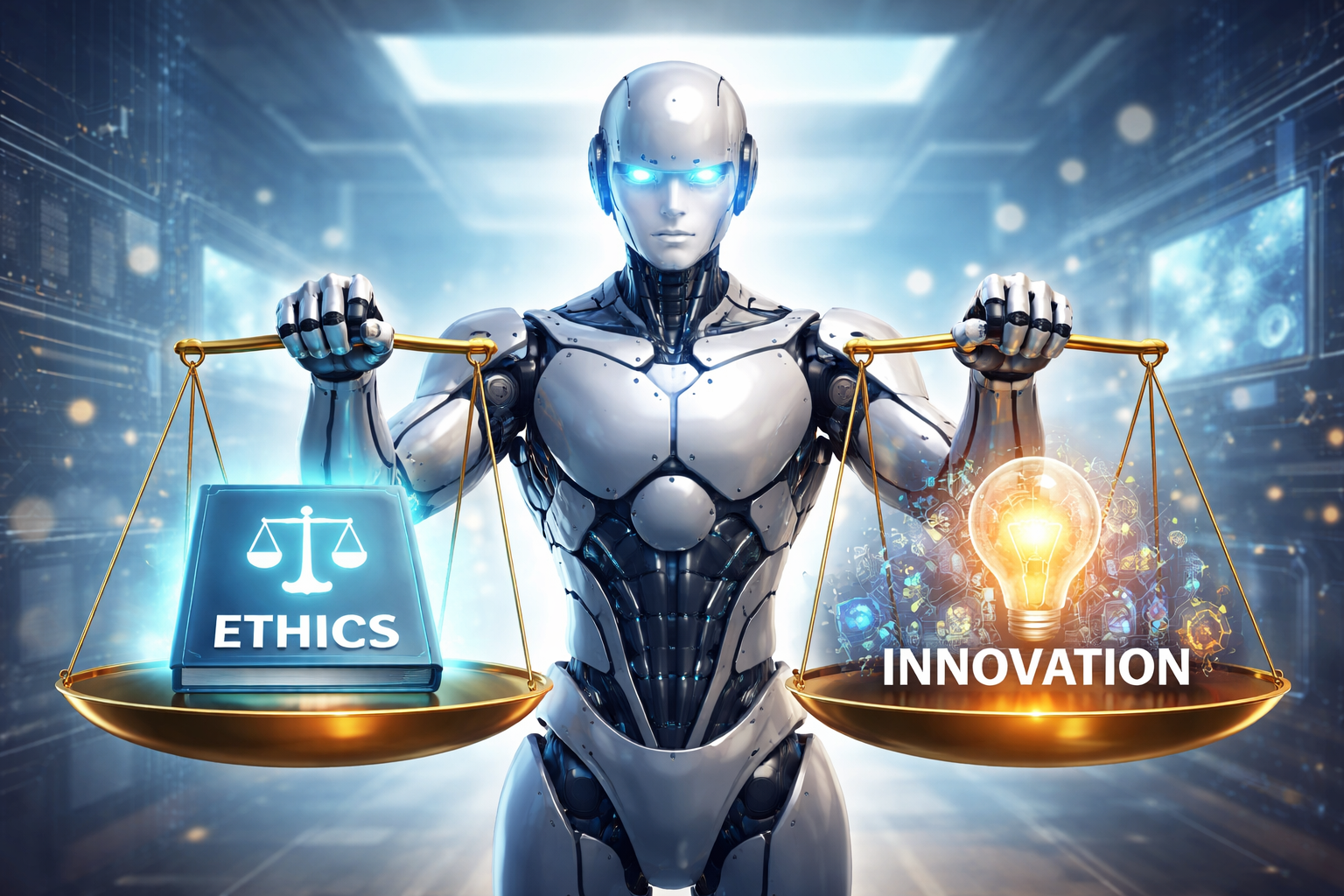
Artificial Intelligence (AI) has transformed from a futuristic concept into an everyday reality. From personalized shopping recommendations to autonomous vehicles and healthcare diagnostics, AI is revolutionizing industries and lifestyles. Yet, as this technology grows more powerful, so does the need for ethical oversight. The race to innovate is faster than ever, but the challenge lies in ensuring that this innovation remains fair, transparent, and beneficial to humanity.
The Rise of Ethical Concerns in AI
AI systems learn from data—and data reflects human society, complete with its biases, errors, and inequalities. When algorithms are trained on biased datasets, they can unintentionally amplify discrimination. Examples like biased hiring tools, skewed credit scoring, and unequal facial recognition accuracy have raised alarms worldwide.
Governments, researchers, and global organizations are now recognizing that the question is no longer “Can we build it?” but rather “Should we build it—and how?” Ethical AI has thus become a defining topic for 2026 and beyond.
Why AI Ethics Matters
Ethics in AI is not just about avoiding harm—it’s about building trust. For any AI system to gain public acceptance, users must believe it operates fairly and responsibly. Ethical AI promotes:
-
Transparency – People should understand how AI decisions are made.
-
Accountability – Developers and organizations must take responsibility for outcomes.
-
Fairness – AI should not discriminate based on gender, race, or socioeconomic background.
-
Privacy – Personal data must be handled securely and ethically.
Without these principles, the technology risks being seen as manipulative or untrustworthy—undermining its own progress.
Key Ethical Challenges in AI Development
-
Data Bias and Fairness
The quality of an AI model depends heavily on the data it’s trained on. Historical or unbalanced datasets can embed social prejudices directly into algorithms. For instance, if an AI recruitment tool is trained on data dominated by male employees, it might unconsciously favor male applicants in future hiring.
To combat this, companies are adopting bias detection frameworks and diverse data training methods that encourage inclusion. -
Transparency and Explainability
Many AI systems, especially deep learning models, function like “black boxes.” Even developers often struggle to explain exactly how these systems reach their conclusions.
Ethical AI demands explainable models—those that can justify their reasoning. Tools like LIME and SHAP are helping decode complex algorithms, making them more understandable to humans. -
Accountability and Governance
When an AI makes a wrong or harmful decision, who is responsible—the developer, the company, or the algorithm itself?
Ethical frameworks propose establishing AI governance boards and regulatory audits to ensure that decision-making responsibilities are clearly defined. The EU’s AI Act is one of the first major attempts to regulate such accountability globally. -
Privacy and Surveillance
AI thrives on data, but the more data it has, the more privacy risks arise. Technologies like facial recognition and predictive analytics can lead to mass surveillance if unchecked.
The solution lies in privacy-preserving AI, which uses methods like federated learning and differential privacy—allowing AI to learn without exposing individual data points. -
Job Displacement and Social Impact
Automation powered by AI promises higher efficiency but also sparks fears of job loss. Ethical AI doesn’t just focus on technology—it also considers societal impact.
Governments and industries must balance AI adoption with reskilling programs and human-AI collaboration models to ensure that workers evolve alongside machines, not against them.
Global Efforts Toward Ethical AI
Around the world, tech leaders are forming ethical AI guidelines to establish universal principles.
-
UNESCO’s Recommendation on the Ethics of AI focuses on human rights and sustainability.
-
Google, Microsoft, and OpenAI have internal ethics committees to review high-risk projects.
-
India’s NITI Aayog has introduced frameworks emphasizing “AI for All” to ensure inclusive benefits.
These initiatives demonstrate that the world is moving toward shared accountability—but enforcing these values across different legal systems and cultures remains a challenge.
The Role of Developers and Businesses
Ethical AI begins at the design stage. Developers must embed fairness, transparency, and privacy into every layer of system architecture. Businesses adopting AI should conduct ethical impact assessments, just as they perform financial audits.
By creating AI that aligns with human values, companies can gain consumer trust and long-term loyalty. In fact, studies show that consumers increasingly prefer brands that prioritize responsible innovation over aggressive automation.
AI and Human Values: A Shared Future
AI is not inherently good or bad—it reflects the intentions of those who create and control it. The goal should be to design AI that enhances human capabilities rather than replaces them.
We need machines that understand empathy, fairness, and context—values that go beyond computation.
The most successful AI systems of the future won’t be those that merely outperform humans, but those that collaborate with humans to build a fairer, smarter world.
Conclusion
The balance between innovation and responsibility defines the future of AI. As we stand on the edge of the next technological revolution, it’s vital to remember that progress without ethics is progress without direction.
Building ethical AI is not a limitation—it’s an evolution. It ensures that technology serves humanity, not the other way around. The question now isn’t how fast we can innovate, but how responsibly we can do it.