
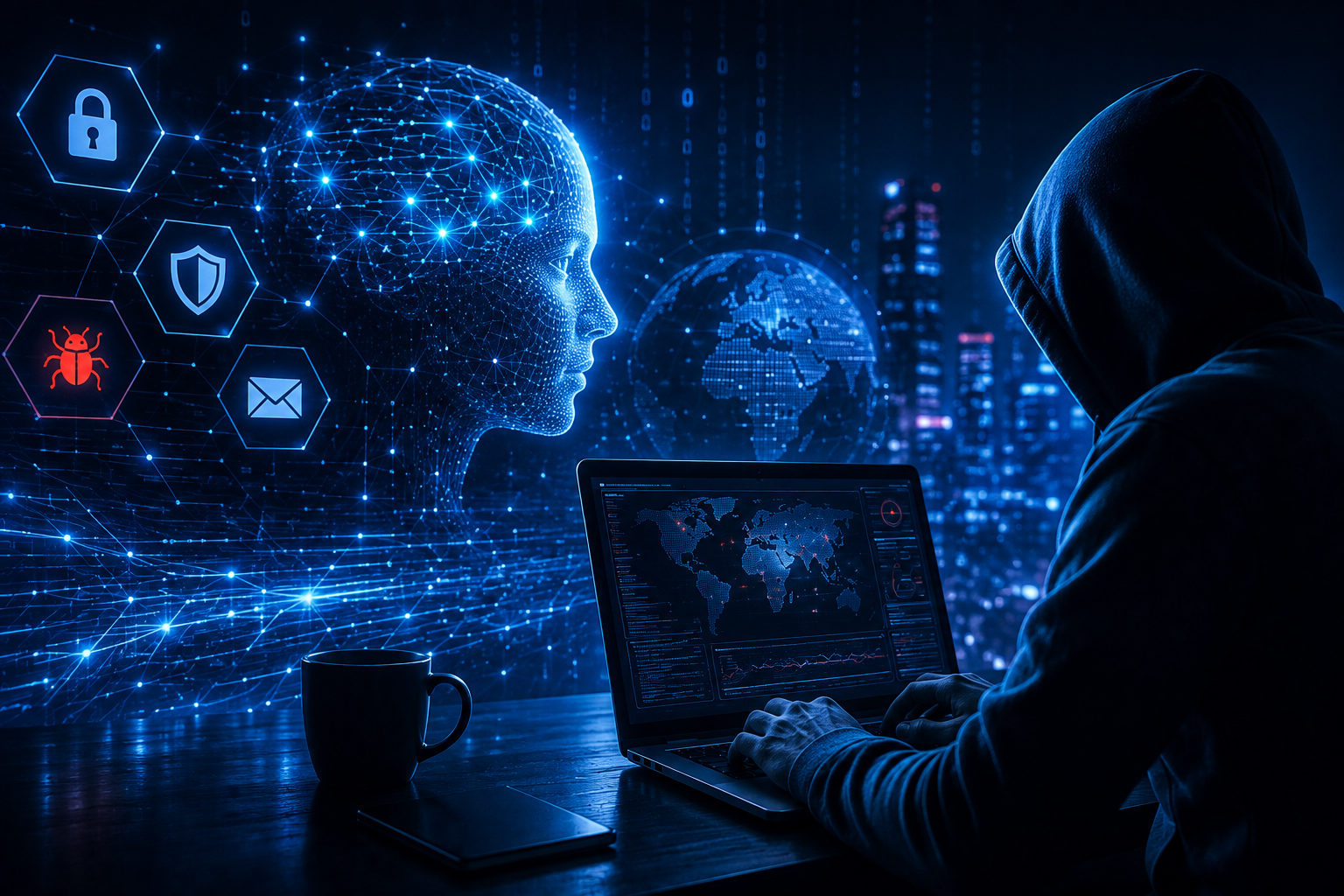
Artificial intelligence is changing almost every part of the digital world, and cybersecurity is no exception. While businesses use AI to detect threats, monitor networks, and protect sensitive information, cybercriminals are also using the same technology to make attacks faster, smarter, and harder to detect.
In 2026, AI-powered cyberattacks are becoming a major cybersecurity concern for individuals, companies, and governments. Attackers can use AI to create convincing phishing messages, automate attacks, identify vulnerable systems, generate malicious code, and manipulate people through highly personalized scams.
The good news is that AI can also become one of the strongest tools for cybersecurity. Understanding how AI-powered hackers operate and adopting basic security practices can significantly reduce your risk.
What Are AI-Powered Cyberattacks?
AI-powered cyberattacks are cyber threats that use artificial intelligence or machine learning to improve the speed, scale, personalization, or effectiveness of an attack.
Traditional cyberattacks often require significant manual work. Attackers may need to research victims, write convincing emails, identify vulnerabilities, or analyze stolen data.
AI can automate many of these tasks.
For example, an attacker can use AI to analyze publicly available information about a target and create a phishing message that looks highly personalized. AI can also help criminals generate multiple variations of scams, making it easier to target thousands of people.
This does not mean AI has completely replaced traditional hacking techniques. Instead, it is becoming a powerful tool that makes existing cyber threats more efficient.
Why AI Makes Cyberattacks More Dangerous in 2026
The biggest advantage AI gives cybercriminals is automation.
An attacker no longer needs to manually create every phishing email or research every potential victim. AI systems can process large amounts of information quickly and generate targeted content at scale.
Some of the biggest concerns include:
- Automated phishing campaigns
- AI-generated social engineering
- Deepfake voice and video scams
- Automated vulnerability discovery
- Malicious code generation
- Password and credential attacks
- Automated reconnaissance
- Faster malware development
- More convincing business email scams
As AI technology becomes easier to access, the barrier to entry for cybercrime may also become lower.
AI-Powered Phishing Is Becoming More Convincing
Phishing remains one of the most common cybersecurity threats, but AI is making phishing messages harder to recognize.
Older phishing emails often contained obvious spelling mistakes, strange formatting, suspicious links, or generic messages.
AI can help attackers produce messages with better grammar, natural language, and personalized information.
For example, instead of receiving a generic message saying:
“Your account has been blocked. Click here.”
A targeted scam may reference a real company, recent transaction, employee name, project, or business activity.
This is why simply looking for spelling mistakes is no longer enough to identify phishing.
How to protect yourself
Always verify unexpected requests involving:
- Passwords
- Payments
- Bank information
- One-time passwords
- Account recovery
- Confidential documents
- Cryptocurrency transfers
- Login credentials
If a message creates urgency or pressure, slow down and verify it through an independent communication channel.
Deepfake Scams Are a Growing Cybersecurity Threat
AI-generated audio and video can make impersonation scams much more convincing.
Cybercriminals may attempt to imitate executives, family members, employees, or public figures. A fake voice call could appear to come from a manager requesting an urgent payment. A manipulated video could be used to create a false impression of a person saying something they never actually said.
This type of attack is particularly dangerous because people naturally trust familiar voices and faces.
How to stay safe from deepfake scams
Do not rely only on someone’s voice or video appearance to verify their identity.
For sensitive requests:
- Contact the person using a trusted phone number.
- Verify unusual payment requests.
- Use established approval procedures.
- Avoid sharing sensitive information during unexpected calls.
- Create a verification phrase or internal process for high-value transactions.
A simple verification process can prevent a sophisticated AI scam from becoming a serious financial loss.
AI Can Help Hackers Find Vulnerabilities Faster
Cybercriminals can use automation to scan websites, applications, and networks for weaknesses.
A vulnerable plugin, outdated software package, exposed service, or poorly configured server can become an entry point for attackers.
This is especially important for businesses running websites and eCommerce platforms.
WordPress, Shopify integrations, custom applications, APIs, cloud services, and third-party plugins should all be maintained and monitored regularly.
Protect your website and applications
Businesses should:
- Keep software updated.
- Remove unused plugins and applications.
- Use strong administrator passwords.
- Enable multi-factor authentication.
- Regularly review user permissions.
- Secure APIs.
- Monitor login attempts.
- Use HTTPS.
- Maintain reliable backups.
- Perform regular vulnerability assessments.
- Protect administrative dashboards.
Security should be treated as an ongoing process rather than a one-time setup.
AI-Generated Malware and Malicious Code
Another concern is the use of AI to assist with malicious software development.
AI can potentially help attackers understand programming concepts, automate repetitive tasks, analyze code, or modify existing malicious software.
However, AI-generated code is not automatically effective or sophisticated. It can contain mistakes, vulnerabilities, or obvious indicators that security tools can detect.
The larger concern is scale. AI can allow attackers to experiment with more variations in less time.
For defenders, this means traditional signature-based security alone may not be sufficient.
Modern cybersecurity increasingly relies on behavior analysis, threat intelligence, endpoint monitoring, identity protection, and anomaly detection.
Businesses Are a Major Target
Businesses have become attractive targets because they store valuable information and control financial systems.
A successful attack can expose:
- Customer information
- Employee data
- Payment information
- Business documents
- Login credentials
- Intellectual property
- Financial records
- Internal communications
Small businesses can be particularly vulnerable because they may not have dedicated cybersecurity teams.
A company does not need a huge security budget to improve its protection.
Basic security measures can make a significant difference.
How Businesses Can Protect Against AI-Powered Hackers
1. Enable Multi-Factor Authentication
Passwords alone are no longer enough for important accounts.
Multi-factor authentication adds another verification step and can protect accounts even when passwords are compromised.
Enable MFA for:
- Cloud services
- WordPress administration
- Hosting accounts
- Banking
- Payment platforms
- Social media
- Developer platforms
2. Use Strong and Unique Passwords
Never reuse the same password across multiple services.
If one website suffers a data breach, attackers may attempt to use the same credentials on other platforms.
A password manager can help create and store unique passwords securely.
3. Keep Software Updated
Software updates often include security fixes.
Delay in updating operating systems, plugins, themes, browsers, applications, and server software can leave known vulnerabilities exposed.
For websites, remove outdated plugins and themes that are no longer maintained.
4. Train Employees
Technology cannot completely protect a company from social engineering.
Employees should know how to recognize suspicious:
- Emails
- Links
- Attachments
- Login pages
- Payment requests
- Phone calls
- QR codes
- AI-generated messages
Regular security awareness training can reduce the chance of human error.
5. Create a Backup Strategy
Backups are essential during ransomware attacks and other security incidents.
Keep multiple backup copies and make sure at least one backup cannot be easily modified or deleted by an attacker.
Most importantly, test your backups regularly.
A backup that cannot be restored is not a reliable backup.
How Individuals Can Protect Themselves in 2026
You do not need to be a cybersecurity expert to improve your online security.
Start with these simple habits:
Use MFA: Enable two-factor or multi-factor authentication wherever possible.
Check URLs: Before entering credentials, carefully verify the website address.
Avoid urgent decisions: Scammers often create fear and urgency.
Protect your email: Your primary email account can be the gateway to many other accounts.
Update your devices: Install security updates promptly.
Use a password manager: Create unique passwords for important accounts.
Be careful with QR codes: A QR code can lead to a malicious website just like a suspicious link.
Verify unexpected requests: Especially requests involving money, passwords, or sensitive information.
Limit public information: Information shared publicly can help attackers create more convincing social engineering attempts.
Can AI Also Defend Against AI Hackers?
Absolutely.
AI is not only a weapon for attackers. Cybersecurity companies and security teams are using AI to detect suspicious activity, analyze massive amounts of data, identify unusual behavior, and respond to threats faster.
AI-powered security systems can help identify patterns that might be difficult for humans to detect manually.
For example, an AI-based security system may detect unusual login behavior, suspicious network traffic, abnormal account activity, or unexpected changes in user behavior.
The future of cybersecurity is therefore likely to involve AI vs. AI.
Attackers will use automation to discover and exploit weaknesses, while defenders will use automation to detect and stop them.
The Human Factor Still Matters
Despite advances in artificial intelligence, humans remain an important part of cybersecurity.
A sophisticated security system can still be undermined when someone clicks a malicious link, shares a password, approves an unauthorized payment, or gives sensitive information to an impersonator.
That is why cybersecurity should combine technology with awareness.
The strongest security strategy includes:
Technology + Processes + Employee Awareness + Continuous Monitoring
No single security product can guarantee complete protection.
The Future of Cybersecurity in 2026 and Beyond
AI-powered cyber threats are likely to become more sophisticated as artificial intelligence continues to evolve.
We can expect attackers to improve automation, personalization, social engineering, and vulnerability discovery.
At the same time, cybersecurity systems will become more intelligent.
Organizations will increasingly use AI for:
- Threat detection
- Security monitoring
- Fraud prevention
- Identity protection
- Incident response
- Vulnerability management
- Security analytics
The biggest change may be speed.
Cyberattacks that previously required hours or days of manual work could increasingly happen within minutes.
That means businesses need to detect and respond to threats just as quickly.
Final Thoughts
AI-powered hackers are changing the cybersecurity landscape in 2026. From highly personalized phishing attacks and deepfake scams to automated vulnerability discovery, artificial intelligence is giving cybercriminals new ways to attack individuals and organizations.
But AI does not mean that cybersecurity is impossible.
Strong passwords, multi-factor authentication, regular software updates, employee training, secure backups, careful verification, and continuous monitoring can significantly reduce cyber risk.
The most important rule is simple: do not trust a digital message just because it looks professional, sounds familiar, or appears to come from someone you know.
As AI becomes more powerful, cybersecurity awareness will become just as important as cybersecurity technology.
The organizations and individuals that prepare now will be in a much stronger position to protect their data, money, identity, and digital systems in the years ahead.
Frequently Asked Questions
What are AI-powered hackers?
AI-powered hackers are cybercriminals who use artificial intelligence and automation to improve activities such as phishing, social engineering, reconnaissance, vulnerability discovery, and other cyberattacks.
Is AI making cyberattacks more dangerous?
Yes. AI can increase the speed, scale, and personalization of certain attacks. It can help criminals automate repetitive tasks and create more convincing social engineering campaigns.
How can I protect myself from AI-powered cyberattacks?
Use multi-factor authentication, unique passwords, security updates, trusted security software, regular backups, and careful verification of unexpected messages, calls, and payment requests.
Can AI detect cyberattacks?
Yes. AI-based cybersecurity tools can analyze large volumes of activity and help identify suspicious patterns, abnormal behavior, malware, fraud, and other potential threats.
Are deepfakes a cybersecurity threat?
Yes. AI-generated or manipulated audio and video can be used for impersonation, fraud, misinformation, and social engineering.
What is the most important cybersecurity habit in 2026?
Verify unexpected requests before taking action. Never provide passwords, OTPs, financial information, or sensitive documents simply because a message or caller appears legitimate.