
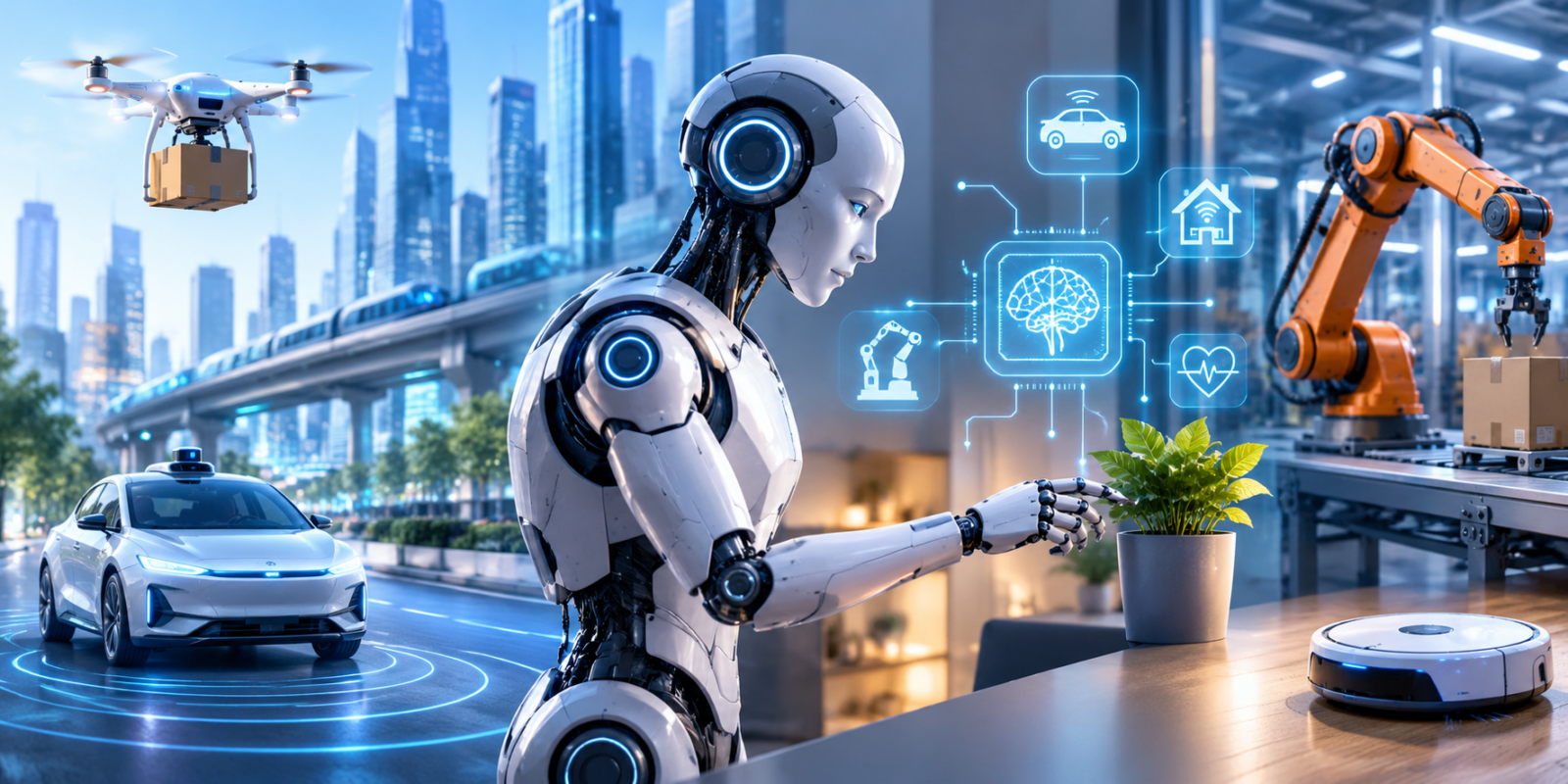
Artificial intelligence has spent the last few years transforming the digital world. AI can write articles, generate images, answer questions, analyze data, create code and automate business tasks. But the next major shift is happening outside the screen.
AI is learning to interact with the physical world.
This new era is often called Physical AI or embodied AI. Instead of simply producing a digital response, Physical AI allows intelligent systems to see their surroundings, understand what is happening, make decisions and take physical action.
Think about the difference between asking an AI assistant to explain how to pick up a cup and giving an AI-powered robot the ability to actually find the cup, reach for it, grasp it and place it somewhere else.
That is the fundamental idea behind Physical AI.
In 2026, robotics researchers and technology companies are increasingly combining foundation models, computer vision, simulation, sensors, robotics and edge computing to build machines that can operate in unpredictable environments.
What Is Physical AI?
Physical AI refers to AI systems that can perceive, reason about and act in the physical world.
Traditional AI mostly operates inside computers. A chatbot receives text and generates text. An image generator receives a prompt and creates an image. A recommendation system analyzes information and suggests something.
Physical AI adds another dimension: action.
A Physical AI system can use:
- Cameras and computer vision
- Microphones and other sensors
- AI models
- Robotics and mechanical systems
- Motors and actuators
- Real-time computing
- Simulation environments
- Edge AI
- Control systems
The basic process looks something like this:
Sense → Understand → Plan → Act → Learn
For example, a warehouse robot could use cameras to identify a package, understand its location, plan a route, move toward it, pick it up and deliver it to another location.
IBM describes Physical AI as AI systems that interact with physical environments through combinations of models, sensors, actuators and control systems.
Why Physical AI Is Different From Traditional AI
The biggest difference is the environment.
Software-based AI works primarily with digital information. Physical AI has to deal with the messy, unpredictable nature of the real world.
A chatbot doesn’t have to worry about whether a table suddenly moves.
A robot does.
A software AI can generate a perfect description of how to pick up an object. A robot actually has to determine the object’s position, shape, weight, surface and grip before attempting the movement.
This makes Physical AI significantly more complicated.
Real-world AI systems must handle:
- Changing lighting
- Moving people
- Unexpected objects
- Different surfaces
- Physical obstacles
- Mechanical limitations
- Network delays
- Sensor errors
- Safety requirements
- Unpredictable environments
This is why making AI intelligent inside a computer is only one part of the challenge. Making it reliable in the physical world is much harder.
How Does Physical AI Work?
Physical AI usually combines several technologies rather than relying on one AI model.
1. Sensors Give AI Eyes and Ears
A robot needs information about its surroundings.
Cameras can help it understand objects and people. Depth sensors can estimate distance. Microphones can detect sounds or voice commands. Other sensors can measure temperature, pressure, movement and physical contact.
The AI uses this information to create an understanding of its environment.
2. AI Models Understand the Environment
Once the system collects information, AI models analyze it.
Computer vision can identify objects. Language models can interpret instructions. Specialized models can estimate movement or predict what could happen next.
This is where Physical AI begins to look different from traditional robotics.
Instead of programming every possible situation manually, developers can train AI systems to generalize across different environments.
3. World Models Help AI Predict What Happens Next
One of the most important developments in Physical AI is the use of world models.
A world model attempts to give an AI system an understanding of how the environment behaves.
For example, if a robot pushes a box, the system should understand that the box may move. If the robot picks up a glass, it needs to understand that excessive force could break it.
Modern research is increasingly using simulation and world models to help AI systems learn about physical environments before operating in the real world.
4. AI Plans the Action
After understanding its surroundings, the AI needs to decide what to do.
Suppose you tell a household robot:
“Put the books on the table into the shelf.”
The robot has to break that instruction into multiple actions:
- Locate the books.
- Identify the table.
- Find the shelf.
- Navigate toward the table.
- Pick up each book.
- Move toward the shelf.
- Place the books correctly.
- Confirm that the task is complete.
This ability to turn natural-language instructions into physical actions is one of the major goals of modern robotics research.
5. Actuators Turn Decisions Into Movement
Finally, the robot needs to physically execute the decision.
Motors, robotic arms, wheels, grippers and other mechanical components allow the system to interact with the environment.
The AI isn’t simply generating an answer anymore.
It is controlling something that can physically change the world.
Physical AI vs Generative AI
Generative AI and Physical AI are closely connected, but they are not exactly the same.
| Generative AI | Physical AI |
|---|---|
| Creates digital content | Interacts with the physical world |
| Works mainly with text, images, audio or code | Works with robots, vehicles and machines |
| Produces information | Produces actions |
| Mostly operates in software | Connects software with hardware |
| Can respond in seconds | Often requires real-time decisions |
| Physical safety is usually not involved | Safety can be critical |
The two technologies are increasingly being combined.
A future robot could use a large AI model to understand your instructions while another system handles perception, movement and safety.
Where Is Physical AI Being Used?
Physical AI has applications across many industries.
Manufacturing
Factories have used robots for decades, but traditional industrial robots usually perform highly specific and repetitive tasks.
Physical AI could make robots more adaptable.
Instead of programming a robot for one exact movement, AI-powered systems can potentially recognize different objects and adjust their behavior.
This could make automation more useful for tasks involving changing products, environments and workflows.
Warehouses and Logistics
Warehouses are another major area for Physical AI.
AI-powered robots can help move packages, navigate facilities, identify products and support picking and sorting operations.
Digital twins and simulation can also allow companies to test robotic workflows virtually before deploying machines in physical warehouses. NVIDIA says its simulation technologies are being used to model facilities and test autonomous robotic systems before real-world deployment.
Autonomous Vehicles
Self-driving vehicles are one of the clearest examples of Physical AI.
A vehicle must:
- Understand roads
- Detect pedestrians
- Recognize vehicles
- Interpret traffic signals
- Predict movement
- Plan routes
- Make decisions
- Control steering and acceleration
Unlike a chatbot, an autonomous vehicle cannot simply make a mistake and generate another answer.
Its decisions happen in the real world.
Healthcare Robotics
Physical AI could also transform healthcare.
Robotic systems may assist with surgery, rehabilitation, hospital logistics and patient support.
However, healthcare requires extremely high standards of reliability, safety and human oversight. Physical AI in healthcare will therefore likely develop more cautiously than consumer applications.
Agriculture
Farmers could use intelligent machines for:
- Crop monitoring
- Weed detection
- Precision spraying
- Harvesting
- Soil analysis
- Autonomous equipment
AI-powered agricultural machines could potentially perform tasks that are difficult to automate using traditional rule-based systems.
Construction
Construction sites are dynamic environments filled with changing objects, workers and equipment.
Physical AI could eventually help robots perform tasks such as inspection, material transportation, mapping and certain repetitive construction activities.
Homes
Perhaps the most exciting long-term possibility is the home.
Imagine telling a robot:
“Clean the kitchen and put everything back where it belongs.”
For a human, that instruction is simple.
For a robot, it is incredibly complicated.
The machine would need to understand objects, recognize where things belong, navigate around furniture, manipulate different objects and adapt when something unexpected happens.
This is exactly the type of problem Physical AI is attempting to solve.
Humanoid Robots and the Physical AI Boom
Humanoid robots have become one of the most visible parts of the Physical AI movement.
The reason is simple: humans have built environments around the human body.
Doors, stairs, shelves, tools and workstations are generally designed for people.
A robot with a human-like body could potentially operate within these environments without requiring every workplace to be redesigned.
In 2026, robotics companies are increasingly demonstrating humanoid robots and other autonomous machines designed for industrial and commercial applications. At the World Robot Conference in Beijing, thousands of robotic products were showcased, although experts also noted that many humanoids still face significant limitations in practical everyday tasks.
This distinction is important.
A robot demonstration is not the same thing as a reliable commercial robot.
Physical AI still has a long way to go.
Why Simulation Is So Important
Training robots directly in the real world can be expensive, slow and dangerous.
Imagine trying to teach a robot how to pick up 100,000 different objects by physically testing every possibility.
It would take enormous amounts of time.
Simulation provides an alternative.
Developers can create virtual environments where robots can practice thousands or millions of actions.
The AI can learn what happens when it moves an object, changes direction or encounters an obstacle.
Researchers then work on transferring what the robot learned in simulation into real-world machines. This process is commonly called sim-to-real.
NVIDIA’s recent robotics research emphasizes simulation-to-real transfer as an important part of developing robots capable of operating in unpredictable environments.
The Role of Edge AI
Physical AI often needs to make decisions quickly.
Imagine an autonomous robot detecting an obstacle.
Sending every sensor reading to a distant cloud server and waiting for a response may introduce unnecessary latency.
Edge AI allows some processing to happen directly on or near the device.
This can provide:
- Faster response times
- Lower network dependence
- Better privacy
- Reduced bandwidth requirements
- More reliable operation
For robots, vehicles and industrial machines, these advantages can be extremely important.
What Are Vision-Language-Action Models?
Another important concept in Physical AI is the Vision-Language-Action (VLA) model.
Traditional language models understand language.
Computer vision models understand images.
Robotic control systems handle movement.
VLA models attempt to connect these capabilities.
A robot could potentially receive a command such as:
“Move the red box to the shelf.”
It can use vision to identify the red box, language understanding to interpret the instruction and action planning to determine how to move it.
Modern robotics platforms are increasingly exploring this combination of vision, language and action reasoning.
What Are the Biggest Challenges?
Physical AI sounds exciting, but there are serious challenges.
Safety
A software mistake might produce incorrect information.
A physical AI mistake could cause damage or injury.
Robots therefore need strong safety mechanisms and reliable control systems.
Data
AI models need huge amounts of useful training data.
The internet provides enormous amounts of text and images, but physical interaction data is much harder to collect.
Researchers need recordings of robots interacting with objects and environments, along with simulations and synthetic data.
Cost
Building advanced robots requires expensive hardware, sensors, processors and engineering.
This makes Physical AI more difficult to scale than purely software-based AI.
Reliability
A robot that succeeds 90% of the time may still be unusable for many important applications.
Physical AI needs to become highly reliable before it can handle critical tasks independently.
Generalization
A robot trained to perform a task in one environment may struggle when the environment changes.
The ultimate goal is to create systems that can adapt instead of requiring complete retraining for every new situation.
Will Physical AI Replace Human Workers?
This is one of the biggest questions surrounding the technology.
The answer is unlikely to be a simple yes or no.
Some repetitive physical jobs could become increasingly automated. At the same time, new jobs will emerge around robot development, maintenance, AI training, deployment, safety and supervision.
The economic impact will depend heavily on how quickly the technology becomes reliable and affordable.
Research and industry analysis also suggest that robotics adoption is uneven, with practical and narrowly defined applications likely to deliver value before truly general-purpose robots become common.
Rather than immediately replacing everyone, the early stage of Physical AI is more likely to focus on augmenting human workers and automating specific tasks.
Physical AI in India
India could become an important market for Physical AI.
The country has a large manufacturing sector, expanding technology ecosystem, growing automation requirements and increasing interest in AI.
Potential applications include:
- Smart manufacturing
- Warehouse automation
- Healthcare robotics
- Agricultural robots
- Autonomous transportation
- Infrastructure inspection
- Retail automation
- Industrial safety
India’s combination of AI adoption, 5G infrastructure and industrial development creates opportunities for intelligent systems that can operate closer to the physical environment.
What Does the Future of Physical AI Look Like?
The long-term vision is bigger than humanoid robots.
Physical AI could eventually become part of almost every major physical system.
Cars could become more autonomous.
Factories could become adaptive.
Warehouses could operate with intelligent robot fleets.
Agricultural machines could make decisions based on individual crops.
Homes could have intelligent robotic assistants.
Hospitals could use autonomous machines for logistics and assistance.
Buildings could use AI to manage energy and physical infrastructure.
The key shift is that AI will no longer be limited to generating information.
It will increasingly perceive the environment, make decisions and perform actions.
Is Physical AI Ready Yet?
Not completely.
There is enormous progress, but today’s systems still have important limitations.
Humanoid robots can perform impressive demonstrations, yet many struggle with simple tasks that humans perform effortlessly. Researchers are still working on reliability, dexterity, reasoning, data collection and safe deployment.
The industry may be entering an important transition period, but the idea of a robot that can reliably perform almost any household or workplace task is still a future goal.
That makes the current period particularly interesting.
The technology is moving from research laboratories and demonstrations toward real-world deployment, but the hardest engineering problems are still being solved.
The Bigger Picture
The first wave of modern AI changed how we interact with information.
Generative AI showed that computers can understand and produce increasingly sophisticated digital content.
Physical AI takes the next step.
It asks a much harder question:
What happens when AI can actually interact with the world it is trying to understand?
That could change robotics, transportation, manufacturing, healthcare, logistics and everyday life.
The future may not simply be about smarter chatbots.
It could be about smarter machines that can see, understand, move, manipulate and learn.
Physical AI is still developing, but the direction is clear: artificial intelligence is gradually moving from the screen into the real world.
And when software intelligence meets physical machines, the next major chapter of AI may look very different from the one we have experienced so far.
Final Thoughts
Physical AI represents a major evolution in artificial intelligence.
Instead of keeping AI inside computers, developers are connecting intelligence to robots, vehicles, machines, sensors and physical infrastructure.
The technology still faces major challenges involving safety, cost, data, reliability and real-world reasoning. But advances in foundation models, simulation, robotics and edge computing are rapidly expanding what intelligent machines can do.
The most important change may not be the arrival of one particular humanoid robot.
It may be the gradual transformation of ordinary machines into systems that can understand their environment and make intelligent decisions.
That is why Physical AI could become one of the most important technology trends of the next decade.
Frequently Asked Questions
What is Physical AI?
Physical AI is artificial intelligence designed to perceive, reason about and interact with the physical world through robots, vehicles, machines, sensors and other systems.
How is Physical AI different from generative AI?
Generative AI primarily creates digital content such as text, images, audio and code. Physical AI connects intelligence to physical systems that can sense their environment and take action.
Are humanoid robots Physical AI?
Yes. Humanoid robots are one example of Physical AI, but the technology also includes autonomous vehicles, industrial robots, drones, smart machines and other intelligent physical systems.
Will Physical AI replace jobs?
It may automate some repetitive physical tasks, but it is also expected to create demand for new roles involving robotics, AI engineering, maintenance, supervision and deployment.
When will Physical AI become mainstream?
Some forms of Physical AI are already being deployed in factories, warehouses, vehicles and other specialized environments. General-purpose robots capable of performing a wide range of human tasks reliably are still under development.
Why is Physical AI important?
It could extend AI beyond digital tasks and enable intelligent machines to operate directly in the physical world, potentially transforming industries such as manufacturing, logistics, healthcare, transportation and agriculture.